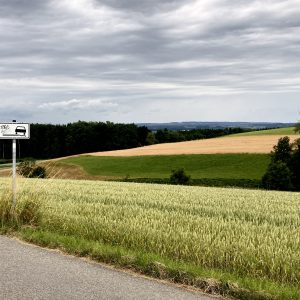
Image from July 2021 depicting the fields around Ravensburg in Southern Germany. There is a sign with some graffiti on which depicts a car sliding off the road, presumably because there is very little curb and it's likely you will career into the grass if you're not careful.

When you can’t pay for things the currency of payment is psychic…

Contributing back to the commons in digital preservation hasn’t been for everyone.

We know the famous XKCD that touches on the underappreciated work of maintainers in obscurity. When you, or your institutions, or services are using free and open source software, or other information and data in the commons, and you’re not contributing back, you’re perpetuating this, and what’s more, there’s a virtuous cycle that we’re missing out on.

I read something the other day and it felt like a red flag.

Loading

"Bei der Buche", a landscape architectural installation by landscape architect and photographer Karina Raeck. Created in 1993 in the Wartberg area north-east of Stuttgart.

wikidata + mediawiki = wikidata + provenance == wikiprov

Today I want to showcase a Wikidata proof of concept that I developed as part of my work integrating Siegfried and Wikidata.

That work is wikiprov a utility to augment Wikidata results in JSON with the Wikidata revision history.

For siegfried it means that we can showcase the source of the results being returned by an identification without having to go directly back to Wikidata, this might mean more exposure for individuals contributing to Wikidata. We also provide access to a standard permalink where records contributing to a format identification are fixed at their last edit. Because Wikidata is more mutable than a resource like PRONOM this gives us the best chance of understanding differences in results if we are comparing siegfried+Wikidata results side-by-side.

I am interested to hear your thoughts on the results of the work. Lets go into more detail below.

Loading

A photograph of a blue neon sign with a quote from Ludwig Wittgenstein's 'Philosophical Investigations: "276. “But don’t we at least mean something quite definite when we look at a color and name our color impression?” It is virtually as if we detached the color impression from the object, like a membrane. (This ought to arouse our suspicions.)"

Infinite Blue @ The Brooklyn Museum

When I visited the Brooklyn Museum in February they were in the middle of their Infinite Blue exhibition. Surveying the entire collection, Infinite Blue collected museum objects that prominently featured the color blue. Part of their Year of Yes: Reimagining Feminism at the Brooklyn Museum.

A Year of Yes: Reimagining Feminism at the Brooklyn Museum presents the history of feminism and feminist art while showcasing contemporary artistic practices and new thought leadership.

While not explicitly stated in their literature, Blue seems to have been selected by the museum’s curators for embodying core feminist values:

In cultures dating back thousands of years, blue—the color of the skies—has often been associated with the spiritual but also signifies power, status, and beauty. The spiritual and material aspects of blue combine to tell us stories about global history, cultural values, technological innovation, and international commerce.

Loading

Rendition of Mondrian: Composition with Grid 1 from the Museum of Fine Arts Houston, remixed by the Painter Goblin

The Painter Goblin Visits The Museum of Fine Arts, Houston: Top Five

I’m heading to Houston for the first time this Friday, for ten-days. I can’t wait! To fill my time before I go, I thought I’d pay tribute to some of the artwork I might find there. Well, I say me, but I mean, I asked The Painter Goblin to make these pieces for me based on what it could find on wikidata.org. I like what it discovered!

Enjoy!

Loading

Two Cats, by John Singer Sargant and remixed by The Painter Goblin. The original can be seen at The Metropolitan Museum in New York

The Painter Goblin Visits The Met’s Top Ten

Inspired by a Creative Commons (CC) blog the Painter Goblin decided to tackle the top-ten visual artworks at The Met Museum (July 2017).

The blog discusses how folks are using CC search to find works held at The Met. The Painter Goblin has been using Wikidata to similar effect – an exploration – a technique grounded in happenstance to discover and understand art held in the fantastic list of institutions that make it available on the Wikidata/Wikimedia service. With little exception, The Painter Goblin cannot replace the original works but hopes that visually interesting/stunning remixes when they appear inspire others to indulge in their own discovery and works of creation.

Let’s see what our elusive basement goblin did with the top-ten listed above…

Loading

Salvador Dali, Set for 'Bacchanale'

The Painter Goblin: Part 5, And Finally…

The work on the Painter Goblin is almost complete for now. The automation of their work is pretty much ironed out with regular tweets happening every night.

A recent favorite:

Maria Krzymuska
Wikidata: https://www.wikidata.org/wiki/Q28727544

I just wanted to round off this series of blogs with some remaining thoughts.

Loading

Starry Night

The Painter Goblin: Part 4, Putting it all together…

Following the previous posts, bringing this all together meant three different applications.

  • paintergoblin.py – creates the images, can be run standalone
  • wikigoblin.py – retrieves data to tweet from the Wikidata SPARQL services
  • twittergoblin.py – tweets for us! Either a random Wikidata image or from am existing Wikidata link

We create Tweetable information using the wikigoblin. We perform the Tweet using twittergoblin. In between the paintergoblin has to create his art!

We’ve seen examples of the images from the original zine.

Persistence of Memory

How do we turn this concept into something real, and automated?

Loading

The Painter Goblin: Part 3, Data Sources

One thing that held the Painter Goblin project back was finding a data source to get images from.

There are potentially hundreds of sources out there, but! The path of least resistance means that:

  • Any source needs either hackable URIs** (uniform resource identifier) or a randomizing function.
  • Ideally, a data source doesn’t link to yet-another-page, e.g. portal like websites to other’s collections.
  • Ideally the data source links directly to an image to download.
  • Data can be easily selected by category, e.g. just paintings, or posters, not just ‘art’.

** A hackable URI is a URI pattern that can be cycled through using computational techniques, even if the underlying data isn’t entirely well-known. E,g, http://example.com/image/0001, http://example.com/image/0002, for subsequent pages, for lack of a more concrete example.

I wanted to explore heritage sources such as Europeana, TROVE, DPLA. I struggled to search these effectively though, and struggled to see how I might automate using them. I recognise they have APIs. I’ll revisit them in the future as I look to expand the Painter Goblin’s corpus.

Enter Wikidata.

Loading

Follow

Get every new post delivered to your Inbox

Join other followers: