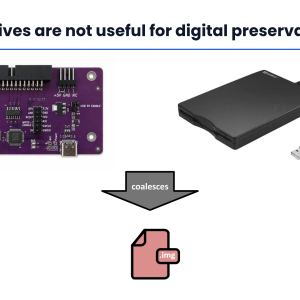
Image provides a simple illustration that the goal of a flux device and a USB disk drive is to generate a functional disk image

Just one more thing: Myths, Risks and Realities of Floppy Disk Preservation

A few weeks back, along with colleagues, Leontien, Tyler, and Julianna, we presented a paper at iPRES 2026 titled: Myths, Risks and Realities of Floppy Disk Preservation

The abstract read as follows:

Thorsted, Tyler; Talboom, Leontien; Spencer, Ross; Barrera-Gomez, Julianna

Brigham Young University, United States of America; University of Cambridge Libraries & Archives; Independent Researcher; Harvard University Library

Floppy disks remain vital for accessing early digital collections, yet online forums and blogs circulate many untested myths around these carriers. This paper examines common claims about reading disks; handling, cleaning, storage and media fragility; evaluating them in the context of contemporary workflows. Drawing on practical experience, targeted testing, and collaboration with conservation experts, we distinguish between theoretical risks and real-world workflows. By situating online advice within our own preservation practice, we provided a grounded perspective that helps preservation practitioners navigate legacy media.

We were taken aback to learn that the contribution had been shortlisted, and indeed, won the Angela Dappert Memorial Award for Digital Preservation, selected by Angela’s partner, Adam Farquhar of Digital Lifecycle Management,
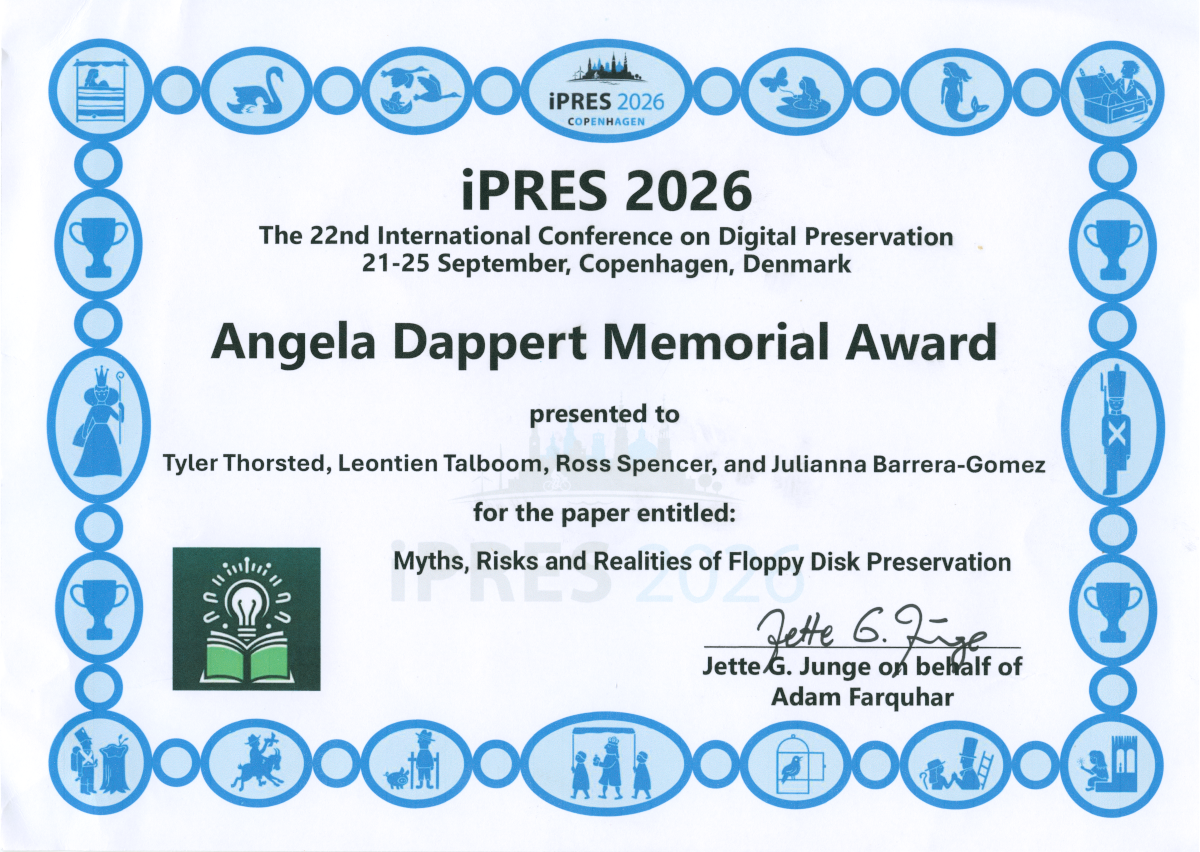
Image of the Angela Dappert Memorial Award 2026 presented to Tyler Thorsted, Leontien Talboom, Ross Spencer, and Julianna Barrera-Gomez for the paper entitled: Myths, Risks, and Realities of Floppy Disk Preservation

I am still speechless, as I am sure the rest of the team is as well. It is such a privilege to receive this award, and I am incredibly grateful to Adam for selecting us alongside previous recipients.

  • 2021 – Micky Lindlar, Merle Friedrich, & Miriam Reiche, (TIB (Technische Informationsbibliothek))
  • 2022 – Andrew Jackson (The British Library)
  • 2023 – Meghan Lyon, Grace Bicho (The Library of Congress)
  • 2024 – Klaus Rechert (University of Applied Sciences Kehl); Dragan Espenschied (Rhizome); Rafael Gieschke (University of Freiburg) & Wendy Hagenmaier (Yale University Library)
  • 2025 – Matthew P. Burgess, Peter Brotherton (State Library New South Wales)

In hindsight, having the very last presentation on stage before the final keynote might have been a clue about a potential award? Even if it wasn’t a clue, following in the footsteps of many great presentations at an exceptionally deep, and diverse, conference was quite a bit of pressure.

I suspect we were all a little nervous, I definitely was, and as a result I lost my way in the slides a bit, and there were a few points I really wanted to labor on.

The slides for the presentation are available on Google Drive.

As for those few points I really wanted to emphasize, at least I have a chance to write about them below.

Loading

Example PRONOM signature built using JSONID's simplified syntax and standard encoding rules. The keys read PRONOM FROM JSONID

Declarative all the way down: Building PRONOM signatures with JSONID

PRONOM signatures are a form of declarative language, you describe the anticipated behavior in PRONOM’s regular expression syntax and tools like DROID, FIDO, and Siegfried will interpret those instructions and attempt to match them against different files to return a file format identification.

Normally, you will write PRONOM signatures by hand but doing so for file formats based on other file format building blocks can lead to inconsistencies. Bertrand Caron previously also recognized this in the XML formats that are described with PRONOM signatures on Wikidata.

XML can use single quotes ' (hex: 0x27) and double quotes " (hex: 0x22) for attribute data, and so, do we make a PRONOM signature with multiple sequences anticipating the use of either?

The answer is more often than not likely to be yes, because the appearance of these values are often helpful for identifying boundaries for strings that we know must exist.

But the more file formats that we need to add to PRONOM that are based on foundational formats like XML, or JSON, or similar, the more inconsistencies will creep in, such as sequences that are looking specifically for one byte sequence over another.

The issue extends further if file formats allow data to appear at the beginning of file, or we need to account for a variable amount of white-space, or we want to start thinking about multi-byte character encoding.

We can, and in the XML issue described by myself and Caron, I think the recommendation is very much to create editorial standards for signatures for file formats based on other baseline, structured data formats like XML, JSON, YAML, and so on.

And standards are well and good, but what if tooling could help us?

For JSON this is exactly what I have tried to do in JSONID.

What does this feature look like? And what does it get us? Let’s take a look.

Loading

An slide excerpt from my presentation Declarative Programming for Digital Preservationists showing how network effect can be embraced and side-effects are reduced in the declarative paradigm.

Declarative programming for Digital Preservationists @ NTTW8

Just released on the No Time to Wait (NTTW) YouTube channel is my presentation from NTTW8 in Karlsruhe, Germany. (Slides also available here).

The presentation follows up on my proposal for iPRES 2024 and allowed me to present parts of what was, in the end, a pretty significant paper (in terms of word count).

Some of my reflections on the presentation are below.

Loading

Tyler's Halloween Matryoshka Dolls represent the internal complexities of container file formats. The dolls here have formats attached to them representing different ways they might be nested, with ZIP and OLE2 being the primary containers that can be handled in DROID and Siegfried at present.

A year in file formats 2024

A great write up from Francesca at TNA about the past year for PRONOM via Georgia at the OPF.

It’s great to see the continuing work including vital translation of guides into other languages. Francesca includes a couple of shout outs to some pieces I have contributed in my spare time this year; including a collaborative workshop with Francesca, David, and Tyler at iPRES2024.

Loading

Using a custom Wikibase with Siegfried

In March I was invited by the LD4 Wikidata Affinity Group to talk about my experiences using Wikibase with Siegfried, the file format identification tool. I don’t think I’ve talked about that work on here before but you can find links to my iPRES talk on my ORCID page.

Let’s look at the abstract and the content of the talk below.

Loading

Information Maintainers talk: Something something twenty years open source…

It was back in May, yes, way back when, that Jordan Hale of the Information Maintainers group put the following to me:

I write today to ask if you’d be interested in being our special guest on the next Information Maintainers call … we thought your perspective on working within and maintaining decentralized, small-group systems and development infrastructures would be really rad to hear about. What do you think?

I am a big fan of the Information Maintainers and so I was pretty stoked to be asked. Of course, I jumped at the chance and wrote about “Something something twenty years open source…”

Loading

OPFCON: How has OPF contributed to the international digital preservation community? Where would this community be without OPF?

Last Wednesday and in another life, pre-COVID pandemic, I would have been visiting Vienna again. I visited for the digital preservation conference iPRES for the first time in 2010, and lived there for a short period of time last year.

Now, we’re in the midst of a pandemic and the Open Preservation Foundation (OPF) 10th Anniversary Event could not happen in person but the OPF found a way anyway, and so 9-10 June 2020 became the online event OPFCON.

Fortunate enough have an abstract of mine be considered worthy of a panel towards the end of the event I was able to reflect on the last 10 years. My notes on those and the panel can be found below.

Loading

Header for my talk at the Vienna Institute for Historical Research, reflecting on community and self-development in digital preservation. I touch upon, among other things, community, recognizing privilege, and finding value and meaning in digital records.

Digital preservation at the coalface: or how I learned that glamping doesn’t always involve the vast wilderness

The last Friday of March this year, I was invited by Elizabeth Kata at the IAEA (International Atomic Energy Agency) to give a presentation at the Vienna Institute for Historical Research (Institut für Österreichische Geschichtsforschung). I don’t have a transcript for that day or a complete set of notes that I followed, but here is the essence of the talk. In it, Reflecting on community and self-development in digital preservation; I touch upon, among other things, community, recognizing privilege, and finding value and meaning in digital records.

I began and ended the talk by singing two Waiata, an important part of my previous role at Archives New Zealand. 

Te Manaaki taonga

Te Manaaki taonga
E whakarauika ana I te tini e
E ranga ana I te tira
Hei huruhuru moo te manu ka rere
Hei Poutuumaaro mo te kainga 
Tuituinga koorero tuituinga tangata
Manaaki taaonga manaaki tangata
(Tane chant: Tuituinga koorero tuituinga tangata.
Manaaki taaonga manaki tangata – Hi!)
(Last time Wahine join chant: manaaki tangata – Hi!)

The value/prestige in protecting treasures
They gather/connect the people like the gathering of fish
They weave the party/masses
To be like feathers of a bird that takes flight
To be a strong pillar for our home
The sewing of stories, the sewing of people
The protection of treasures the protection of people

Loading

Follow

Get every new post delivered to your Inbox

Join other followers: