Photographed at the Whitney Museum in 2018 the image shows a print by artist Edward Meneeley from his series IBM drawings. The image is bright green and shows a component of a computer or maybe printer that is stamped across the page. You can find more information at The Whitney: https://whitney.org/collection/works/7225

Shortened links? Expand them and save the URLs

Shortened links are a digital preservation and web archiving nightmare. You can imagine how they need to work:

  1. Create a unique short code for a given (target) URL (like a hash, but far far shorter)
  2. Pair the short code with your URL in a database.
  3. Create a redirect rule on the URL shortening server from the new source URL to the target URL.
  4. Send the shortened link to the caller, e.g. shortURL.com/123badf00d
  5. In-perpetuity: continue to pay for your domain; maintain the database; look after redirect rules during server migrations; ensure duplicate short-codes are not created.

A URL-shortening business in five easy steps.

But what does that mean for digital preservation?

Loading

Wassily Kandinsky's Three Sounds (1926) demonstrates Kandinsky's characteristic use of color and geometric shapes to conjure the image of three sounds, although exactly how is up to interpretation. Triangles in the image seem to form trees and upside-down mountains. While one circle appears to be the sun, other shapes seem to be emitting sound or forming some kind of subterranean life. Kandinsky suffered from synesthesia, so the image is likely an interpretation of what he was able to hear at the time of painting.

Why we do this work…

There aren’t many rewards in a discipline that is about taking the long term view but occasionally something comes up that you can take some pride in.

Last month, Ed Summers put out a call on Mastodon: digipres.club where he was wrestling with a CD-R format that was difficult to recognize. The disks likely held precious data belonging to his late brother.

Much of the search area had already been examined and narrowed down by folks in the community, including Misty de Meo, Roxi Ruuska, Ethan Gates, and Johan van der Knijff who all contributed suggestions and analysis..

Ed was able to share a copy of one of his disk images, and I had some time that I could dedicate to taking a look as well.

Long-story short, we were able to identify the disks, and Ed has written up the background here: https://inkdroid.org/2026/06/12/tascam/

The situation might be familiar to others: a digital file that isn’t recognized by the major file format identification tools, and yet, because of its context, you know it is something that might be important.

I have different experiences with these types of files, sometimes they are valuable (and you want to look after them), sometimes they are not (and it can still benefit you to get rid of them). The process of finding this out often follows a similar path.

In this instance the files turned out to be incredibly valuable and I wanted to elaborate on the path of discovery. Even though it really isn’t very sophisticated, I hope it will be helpful to those with unidentified digital records who might find the task of identifying them quite daunting.

Loading

A homage by Will Burrows to the Ricardian Socialism motto: "The boss needs you, you don't need them -- Labor is entitled to all it creates". The image shows Quark, O'Brian, and Leeta discussing this while sharing a drink in the bar. The poster pays homage to the poster circa 1968 with the same phrase.

Maintenance begins at creation, so why are we not creating better?

The beats are the same. You work for government, or academia (lets face it, that’s probably where 90% of the work is) you have a deliverable; you save it; you print to PDF; you store it on an institutional repository with some metadata (or Zenodo, OSF or equivalent) and its done.

There’s a small chance that it’s FAIR (Findable, Accessible, Interoperable, Reusable) right? It has metadata that can be discovered by an audience looking for it and can be indexed by search engines. The data is potentially accessible if published correctly. They’re not particularly interoperable or easily converted, and PDFs aren’t really designed for reuse, even if tools like Apache Tika help ease the burden of extracting artifacts. It’s just a PDF, why are we even talking about FAIR? There begins a story…

The beats are the same, yet, we work in digital preservation, our backgrounds are in GLAM or software, why do we want to shoot ourselves in the foot? Why are we not using our skills to create better?

Loading

Does the future look bright? Or are we entering digital dark times? Image is a photo of a poster taken in Ravensburg, September 2021. The original image is from Benni Erbsland from the Erwegung fur Radikale Empathie (Movement for Radical Empathy) based out of Stuttgart: https://bewegung-fuer-radikale-empathie.de/benni-erbsland/

Digital dark times: Salaries in digital preservation

The Serpentine is one of the world’s most renowned art galleries. Their exhibitions as varied as Gerhard Richter, Damien Hirst, and Marina Abramović. They don’t hold a permanent collection, instead, they provide a space for temporary collections and an annual pavilion, the pavilion designed by luminaries such as Zaha Hadid, Frank Gehry, and Ai Weiwei.

Given a recent job posting it looks like they are looking at maintaining their memory better and branching out into digital preservation.

Here’s the kicker — its salary band is GBP 35,000 to GBP 38,000. So it must be an entry level position, especially in London, right?

Well, let’s see what they want you to do for that price tag…

Loading

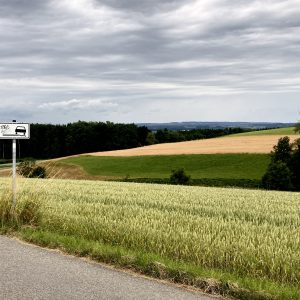
Image from July 2021 depicting the fields around Ravensburg in Southern Germany. There is a sign with some graffiti on which depicts a car sliding off the road, presumably because there is very little curb and it's likely you will career into the grass if you're not careful.

When you can’t pay for things the currency of payment is psychic…

Contributing back to the commons in digital preservation hasn’t been for everyone.

We know the famous XKCD that touches on the underappreciated work of maintainers in obscurity. When you, or your institutions, or services are using free and open source software, or other information and data in the commons, and you’re not contributing back, you’re perpetuating this, and what’s more, there’s a virtuous cycle that we’re missing out on.

I read something the other day and it felt like a red flag.

Loading

Crayola's 1997 Techno Brite crayon set with color names created to market the Crayola website, including names featured here such as World Wide Web Yellow, Point and Click Green, and Cyber Space Orange

Looking after your URLs: tikalinkextract eight years on

We might not have a second life, but what if I told you there was a second internet? Not the deep web, but another web that we engage with nearly every day?

Think about it, that QR code you scanned for more information? That payment link you followed on your electricity bill? The website you’re told to visit at the end of a television ad?

The antipodes of the internet are these terminal endpoints, material and not necessarily material objects that represent the end of the freely navigable web — the QR code on a concert poster is the web printed onto the physical world. There is every chance it will be scanned and followed by someone from a mobile device, but it’s a transient object, something that will exist for a short amount of time, and then disappear into the palimpsest of the poster board or wall it was pasted on until it eventually disappears.

This is part of the materiality of the internet that has long fascinated me. Perhaps it comes from being a student of material culture, but if we look around, we see the Internet everywhere!

Loading

A screenshot of a file format (fmt/983) in 0xffae. The title 0xffae sits over the top of the original image.

File formats as Emoji: 0xffae

tldr: https://emoji.exponentialdecay.co.uk

File Formats As Emoji (0xFFAE or 0xffae) might be my most random file format hack yet. Indeed, it is a random page generator! But it generates random pages of file formats represented as Emoji.

The idea came in 2016 with radare releasing a new version that supported an emoji hexdump. I wondered whether I could do something fun combining file formats and the radare output to create a web-page.

Along came a spare moment one weekend, some pyscript, and bit of sqlite, et voilà. File Formats as Emoji (0xFFAE) was made a reality.

Loading

Follow

Get every new post delivered to your Inbox

Join other followers: