Just one more thing: Myths, Risks and Realities of Floppy Disk Preservation
A few weeks back, along with colleagues, Leontien, Tyler, and Julianna, we presented a paper at iPRES 2026 titled: Myths, Risks and Realities of Floppy Disk Preservation
The abstract read as follows:
Thorsted, Tyler; Talboom, Leontien; Spencer, Ross; Barrera-Gomez, Julianna
Brigham Young University, United States of America; University of Cambridge Libraries & Archives; Independent Researcher; Harvard University Library
Floppy disks remain vital for accessing early digital collections, yet online forums and blogs circulate many untested myths around these carriers. This paper examines common claims about reading disks; handling, cleaning, storage and media fragility; evaluating them in the context of contemporary workflows. Drawing on practical experience, targeted testing, and collaboration with conservation experts, we distinguish between theoretical risks and real-world workflows. By situating online advice within our own preservation practice, we provided a grounded perspective that helps preservation practitioners navigate legacy media.
We were taken aback to learn that the contribution had been shortlisted, and indeed, won the Angela Dappert Memorial Award for Digital Preservation, selected by Angela’s partner, Adam Farquhar of Digital Lifecycle Management,
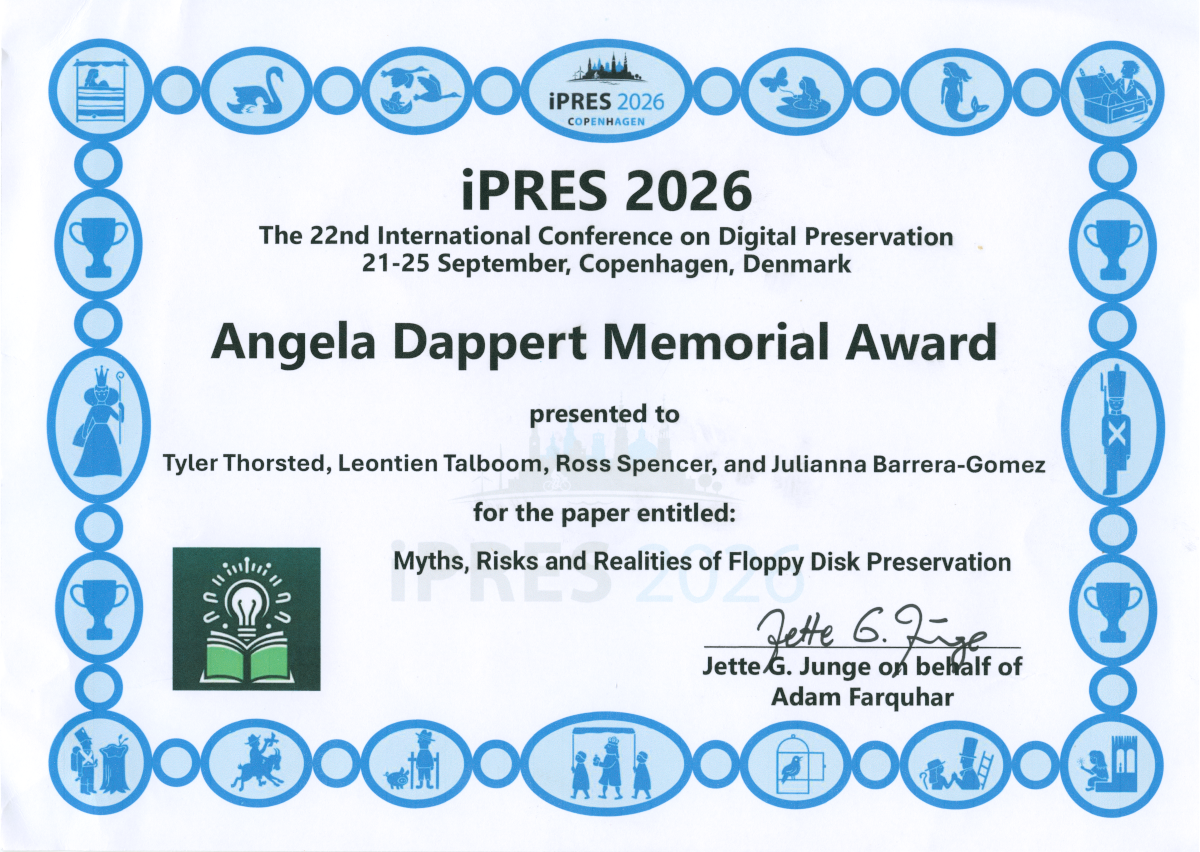
I am still speechless, as I am sure the rest of the team is as well. It is such a privilege to receive this award, and I am incredibly grateful to Adam for selecting us alongside previous recipients.
- 2021 – Micky Lindlar, Merle Friedrich, & Miriam Reiche, (TIB (Technische Informationsbibliothek))
- 2022 – Andrew Jackson (The British Library)
- 2023 – Meghan Lyon, Grace Bicho (The Library of Congress)
- 2024 – Klaus Rechert (University of Applied Sciences Kehl); Dragan Espenschied (Rhizome); Rafael Gieschke (University of Freiburg) & Wendy Hagenmaier (Yale University Library)
- 2025 – Matthew P. Burgess, Peter Brotherton (State Library New South Wales)
In hindsight, having the very last presentation on stage before the final keynote might have been a clue about a potential award? Even if it wasn’t a clue, following in the footsteps of many great presentations at an exceptionally deep, and diverse, conference was quite a bit of pressure.
I suspect we were all a little nervous, I definitely was, and as a result I lost my way in the slides a bit, and there were a few points I really wanted to labor on.
The slides for the presentation are available on Google Drive.
As for those few points I really wanted to emphasize, at least I have a chance to write about them below.
USB drives?!
I am so grateful that the team gave me the blessing to discuss USB floppy disk drives in the same slide-deck as we discussed magnetic flux devices like the Greaseweazle and the KryoFlux.
The Greaseweazle and KryoFlux are two gold standard floppy disk controllers that enable GLAM institutions to approach the preservation of the material on floppy disks with great security.
They allow us to continue connecting legacy floppy disk drives to modern systems, where the same interfaces we once had no longer exist. They output a reading of the magnetic resonance of a disk, its flux, which enables users to read a disk once and interpret it many times without reading it again – useful for reducing wear and tear on the physical drive and media, and for experimenting with exotic disk formats that might not yet be easily interpreted.
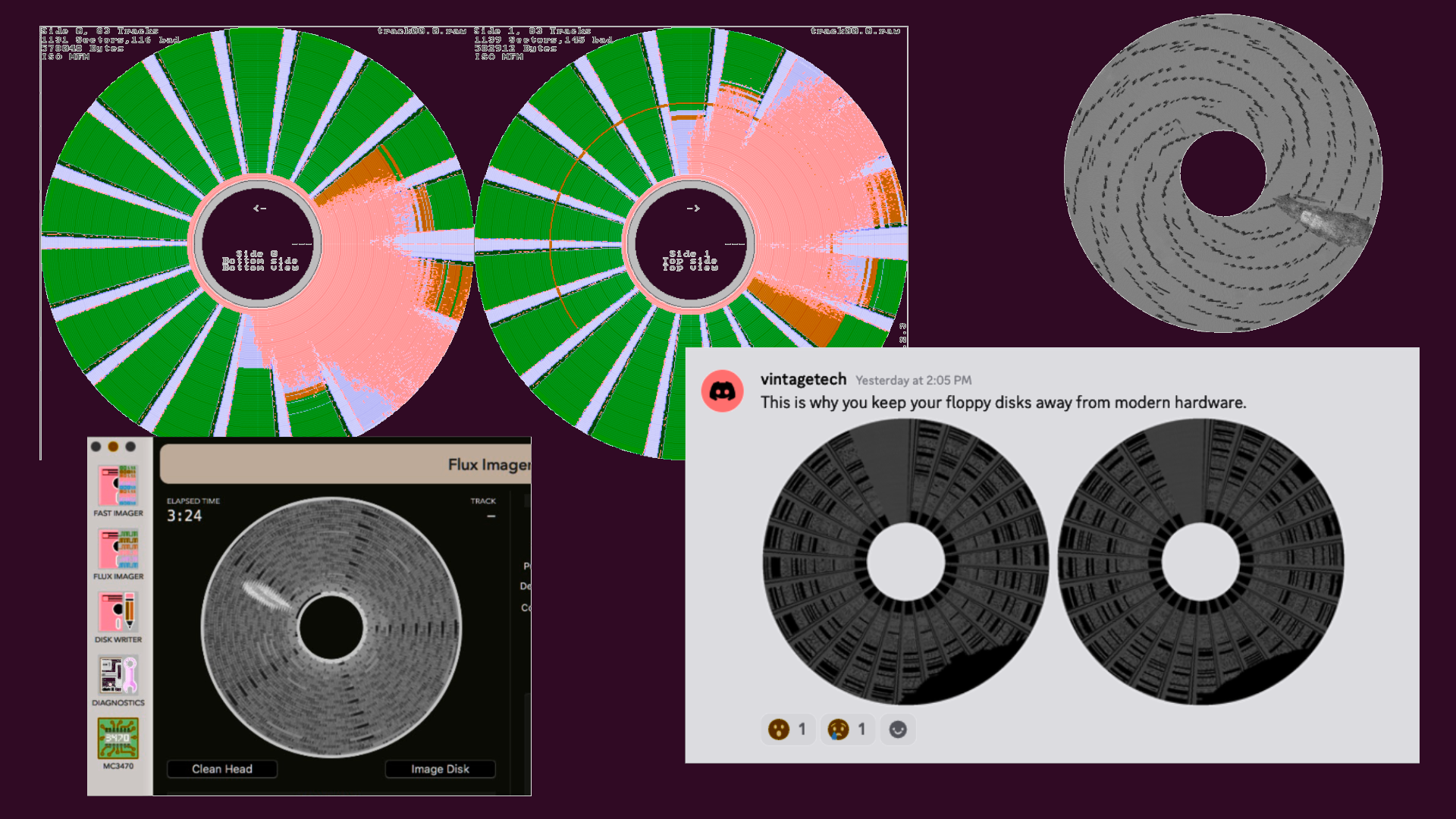
My favorite output of a flux device is the 2D rendering of a disk’s structure and its sectors, analogous to an X-Ray for floppy disks.
From our slides,you can pinpoint exactly where, and how badly damaged some of our disks were through our attempt to analyse the effect of magnetism on their readability.
Another benefit of flux devices is that they work on a greater range of floppy disk drives.
Where USB floppy disk drives really only exist for 3.5-inch disks, flux devices provide a hardware-level controller for 8-inch drives, 5.25-inch drives, and many others. For 3.5-inch drives, they offer greater support for reading disks at different speeds, which isn’t a feature provided by off-the-shelf USB drives and will prevent you from successfully reading, for example, some Macintosh or Amiga disks.
But there’s a sweet spot for the 3.5-inch USB-disk drive and that’s where you will still find them an important device to have in your toolkit.
USB drives can be “good enough”
A message I wanted to relay to the audience is that it is not our sole goal to obtain legacy hardware and flux devices for all of our legacy media needs. First, finding devices is not straight forward, second, as you complete your media surveys in your respective collections and repositories, you may very well find you only have 3.5-inch disks to work with; you might not even find them in great number.
Using the same maintenance and care techniques we describe in our paper to inspect disks and drives and clean them, as well as setting physical write protect features on 3.5-inch disks, you can very quickly sample disks in your collection to determine if more technical means are needed to access their content. If you find USB drives are doing the job, you can easily stick with these.
Flux as a symptom of a missed opportunity
There is a moment in my talk where I discuss our fascination with the form and function of the artifact that is the floppy disk and the devices we use to access it.
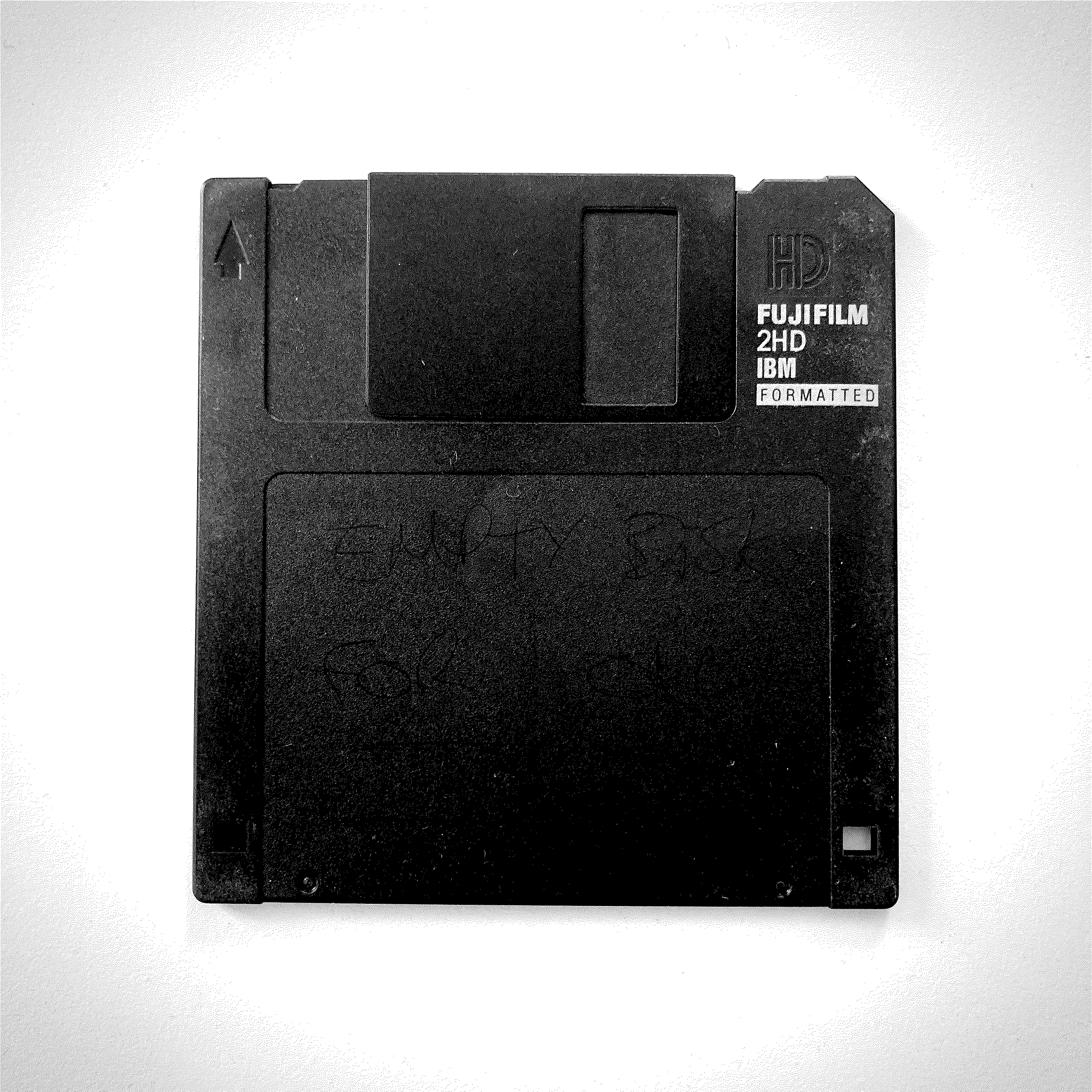
I myself have carted my childhood floppy disk collection around with me for far too long.
It is a critical time for us to be working with the remaining floppy disks we have at home, in our communities, and in our institutions.
But my provocation is that we got lucky this time. Flux devices are a symptom of a missed opportunity. A missed opportunity to perform media migrations sooner than we have been able to, much earlier perhaps than “digital preservation” has even been a burgeoning discipline.
If our field had existed sooner how might things have looked?
- Media migrations might have been performed earlier,
- Print-to-paper would have been more controlled,
- A greater number of devices that were once ubiquitous in the office would have been saved from landfill,
- We would have greater access to mainboards and various different drives,
- Would we promoted the use of the floppy disk?
- Or even lobbied that it was unsuitable for long-term preservation?
- Maybe we would have started research into more stable offline long-term media?
The thought of changing the past is fanciful, and the truth is, floppy disks were massive. I highlighted an article in Storage Newletter where I singled out this passage;
Are Americans also going to give up diskette business? According to several market surveys, 2.3 billion FDs were produced in the world in 1988, and 2.8 billion are forecasted for 1989, then 3.5 billion in 1995. In 1988, 30% of WW volume was produced in Japan, vs. 50% in USA, 11% in Europe and 9% in the rest of the world.
The numbers involved with floppy disks are large. Maybe we will find similar numbers, definitely greater data volume, with CD-ROM, DVD, and Blu-ray; optical media that we should already be tackling in the workplace, both in terms of media migration, and stockpiling the tooling we will need to access them in future.
But my other question to the audience was what, more exotic media might catch us by surprise if we are not careful?
I was fortunate to work with three experts leading the way with floppy disks today: Leontien, Tyler, and Julianna, with others in the audience in attendance, but:
Which three other experts were sitting there or reading this blog that are going to take up the challenge of becoming the world experts with the media that we’re not yet working with to develop tooling and workflows?
When folks get back from iPRES, perhaps they will refresh their media surveys and bring the results with them to the next iPRES? Perhaps you will go further and already start looking at the physical media types not yet demoed at an iPRES conference?!
I look forward to reading your papers.
Forensically, you can have access to the same information
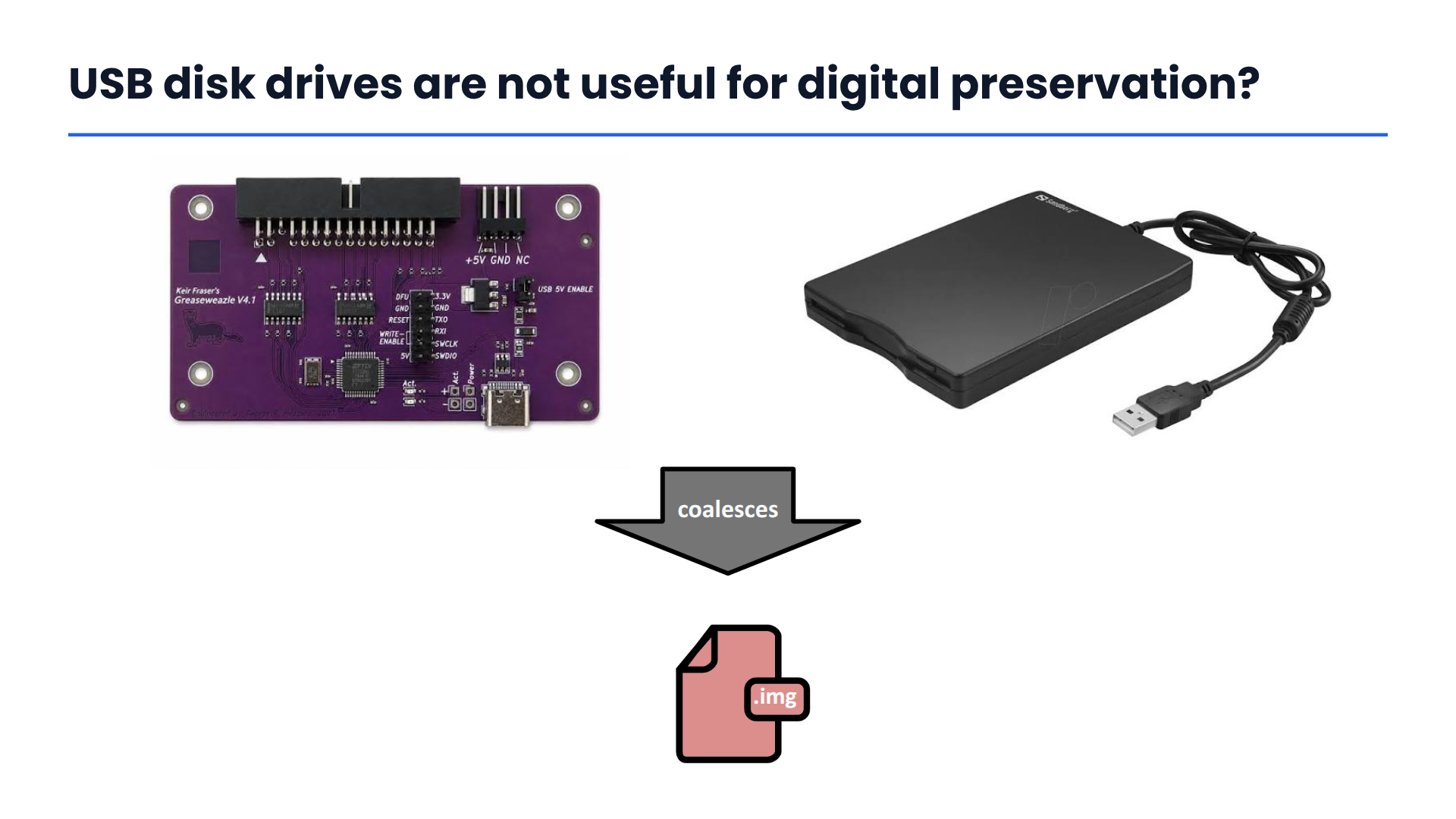
The second point I really wanted to labor is connected to the header image of this blog, that the output of a flux device, and a USB-drive is ultimately the same – both devices are designed to render a disk image. In optimal circumstances the checksum of this image will be exactly the same, no matter the device that it was created from.
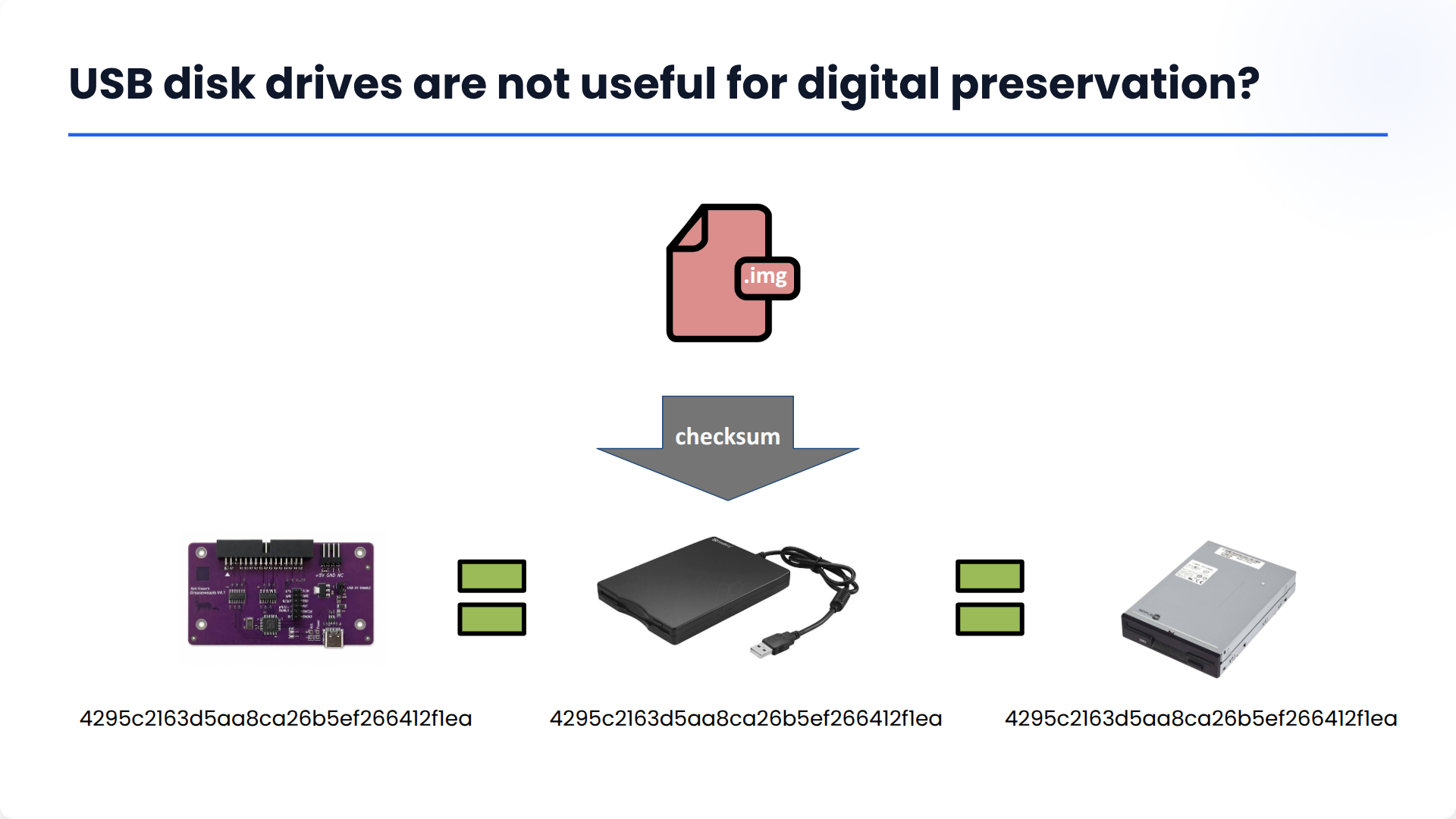
If a disk doesn’t read cleanly, then a flux device has a greater chance of reading more information that can be converted to a disk image but it is by no means a guarantee that the image will be any more readable than what can be rescued from a USB disk drive.
For USB disk drives there are options for retrieving more data than might seem possible at first blush. We can use ddrescue which will use multiple algorithmic passes to read a disk and access as much information as possible. We demonstrated in the paper a case where we could access more data on a disk, largely destroyed by magnet, by asking ddrescue to read the disk five times instead of two.
If you have a flux device, you should absolutely use it!
If you don’t have one, then you still have access to important forensic information:
- A 100% good read will give you a disk image that has ALL the forensic information needed for digital forensics, philology, or other disciplines, as the image created from a flux device.
- A less than 100% read, on a first pass that results in a disk image, provides forensic information that can give you clues about how damaged a disk might be and whether it is worth trying to read again.
- A less than 100% read taken over multiple passes, again, provides forensic information that gives you more detail about the damage. You can also continue to try and reason about what’s on the disk based on details like its directory entries, data boundaries, and other strings found in the file, e.g. by using ‘strings’ to access the disk’s contents.
All this information enables triage and you are building evidence to determine if you need to then invest in a flux device, depending on the value of the collection, the potential of the information that might be on a set of disks, and so on.
If your collection is large enough or important enough to you then you probably have enough evidence to suggest the need for building your lab capacity.
If you aren’t dealing with an important collection and the collection is largely uniform and of unknown (although likely not high, or very high) value then you can absolutely get started with USB disk drives and determine how to build a stronger case for a flux device from there if the case ever needs to be built. In other cases you will hopefully have enough information to determine a disposal action such as destroy, lightening your future work load.
Either way, when you start creating disk images from full or partial disk reads you will, in many cases, have access to either as much forensic data as can be provided by a flux device, or as much as is needed to enable future decision making.
Concluding thoughts
It was a lot of fun presenting our research at the conference. I was laughing with colleagues at the end of the talk about something Tyler discovered and mentioned – that magnets need to be moving to cause damage to a floppy disk’s data. I spent three weeks with a magnet sitting on top of a floppy disk. I kept the magnet in the same position at all times and tried to measure any changes to the disk’s checksums every day. Alas, I never saw any changes, and I think we all started to wonder whether this paper had any validity. Now we know why my very “static” test didn’t work, and we have indeed learned that there might be some value in our paper after all.
I hope it has given you some ideas. I asked what strange and exotic digital media are in your collection that we might not yet have the tools and workflows to access. I absolutely recommend gathering a group of friends to work on it together and write a paper for another iPRES in the future.
As for USB floppy disk drives? They have a place.
As we note in the presentation, they are an entry point to digital forensics and working with floppy disks, and you will use a good percentage of all the skills you need to work with floppy disks and floppy disk drives, e.g. cleaning and maintaining devices. The main difference is that there isn’t a flux device sitting between the disk drive and the computer, and you won’t necessarily be performing all of the low level analysis needed to generate specific disk images from flux streams. If you’re lucky though, it’s not something your collection will need – USB disk drives might be the beginning of your journey in digital forensics, and they might even be your destination.
Importantly, USB floppy disk drives are commodity devices that are widely available and still exist to potentially help us manage the volume of 3.5-inch disks that might still be out there.
Further reading
Copy That Floppy!
Leontien led a successful crowd sourcing group in the creation of the Copy That Floppy, a guide for imaging floppy disks for long-term preservation. A vital resource for your future forensics journey.
Kryoflux manual
Dorothy Waugh and Shira Peltzman in 2017 led a crown sourcing effort to develop a draft guide for working with KryoFlux at your institution and may still prove valuable for working with those tools.
- An Archivist’s Guide to KryoFlux at the DPC.
Data Museum, Copenhagen
Poul-Henning Kamp from the Danish Data Museum shared with us a guide on everything he wish he had known going into floppy disk preservation. There’s a lot of information here and many pretty images:
Poul-Henning also maintains a collection of tools for working with flux images and disks, and the Data Museum has a wiki that may prove useful to folks reading this blog (right-click -> translate, to translate to your locale).
- Data Museum tools on Codeberg.
- Data Museum Wiki.

@exponentialdecay
This was the absolutely best presentation as far as I'm concerned.
Remote Reply
Original Comment URL
Your Profile
Why do I need to enter my profile?
This site is part of the ⁂ open social web, a network of interconnected social platforms (like Mastodon, Pixelfed, Friendica, and others). Unlike centralized social media, your account lives on a platform of your choice, and you can interact with people across different platforms.
By entering your profile, we can send you to your account where you can complete this action.
@bsdphk @exponentialdecay it means a lot, thank you! 🙏
Remote Reply
Original Comment URL
Your Profile
Why do I need to enter my profile?
This site is part of the ⁂ open social web, a network of interconnected social platforms (like Mastodon, Pixelfed, Friendica, and others). Unlike centralized social media, your account lives on a platform of your choice, and you can interact with people across different platforms.
By entering your profile, we can send you to your account where you can complete this action.