
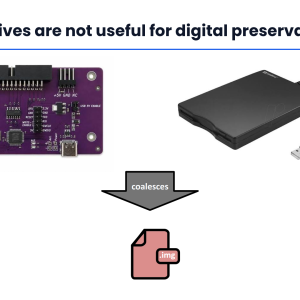
Just one more thing: Myths, Risks and Realities of Floppy Disk Preservation
A few weeks back, along with colleagues, Leontien, Tyler, and Julianna, we presented a paper at iPRES 2026 titled: Myths, Risks and Realities of Floppy Disk Preservation
The abstract read as follows:
Thorsted, Tyler; Talboom, Leontien; Spencer, Ross; Barrera-Gomez, Julianna
Brigham Young University, United States of America; University of Cambridge Libraries & Archives; Independent Researcher; Harvard University Library
Floppy disks remain vital for accessing early digital collections, yet online forums and blogs circulate many untested myths around these carriers. This paper examines common claims about reading disks; handling, cleaning, storage and media fragility; evaluating them in the context of contemporary workflows. Drawing on practical experience, targeted testing, and collaboration with conservation experts, we distinguish between theoretical risks and real-world workflows. By situating online advice within our own preservation practice, we provided a grounded perspective that helps preservation practitioners navigate legacy media.
We were taken aback to learn that the contribution had been shortlisted, and indeed, won the Angela Dappert Memorial Award for Digital Preservation, selected by Angela’s partner, Adam Farquhar of Digital Lifecycle Management,
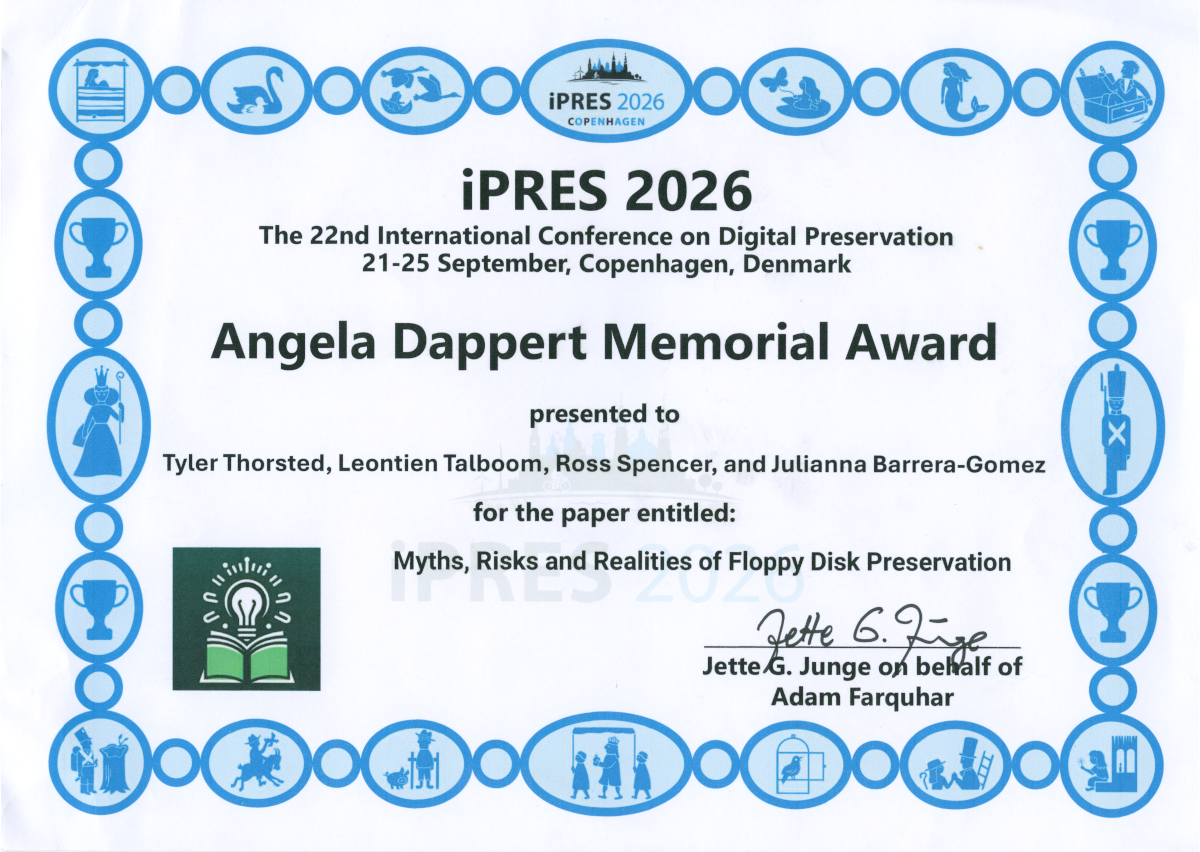
I am still speechless, as I am sure the rest of the team is as well. It is such a privilege to receive this award, and I am incredibly grateful to Adam for selecting us alongside previous recipients.
- 2021 – Micky Lindlar, Merle Friedrich, & Miriam Reiche, (TIB (Technische Informationsbibliothek))
- 2022 – Andrew Jackson (The British Library)
- 2023 – Meghan Lyon, Grace Bicho (The Library of Congress)
- 2024 – Klaus Rechert (University of Applied Sciences Kehl); Dragan Espenschied (Rhizome); Rafael Gieschke (University of Freiburg) & Wendy Hagenmaier (Yale University Library)
- 2025 – Matthew P. Burgess, Peter Brotherton (State Library New South Wales)
In hindsight, having the very last presentation on stage before the final keynote might have been a clue about a potential award? Even if it wasn’t a clue, following in the footsteps of many great presentations at an exceptionally deep, and diverse, conference was quite a bit of pressure.
I suspect we were all a little nervous, I definitely was, and as a result I lost my way in the slides a bit, and there were a few points I really wanted to labor on.
The slides for the presentation are available on Google Drive. The paper itself is now available at the BYU Scholars Archive.
As for those few points I really wanted to emphasize, at least I have a chance to write about them below.


