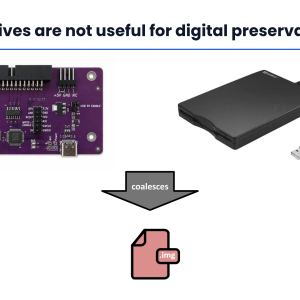
Image provides a simple illustration that the goal of a flux device and a USB disk drive is to generate a functional disk image

Just one more thing: Myths, Risks and Realities of Floppy Disk Preservation

A few weeks back, along with colleagues, Leontien, Tyler, and Julianna, we presented a paper at iPRES 2026 titled: Myths, Risks and Realities of Floppy Disk Preservation

The abstract read as follows:

Thorsted, Tyler; Talboom, Leontien; Spencer, Ross; Barrera-Gomez, Julianna

Brigham Young University, United States of America; University of Cambridge Libraries & Archives; Independent Researcher; Harvard University Library

Floppy disks remain vital for accessing early digital collections, yet online forums and blogs circulate many untested myths around these carriers. This paper examines common claims about reading disks; handling, cleaning, storage and media fragility; evaluating them in the context of contemporary workflows. Drawing on practical experience, targeted testing, and collaboration with conservation experts, we distinguish between theoretical risks and real-world workflows. By situating online advice within our own preservation practice, we provided a grounded perspective that helps preservation practitioners navigate legacy media.

We were taken aback to learn that the contribution had been shortlisted, and indeed, won the Angela Dappert Memorial Award for Digital Preservation, selected by Angela’s partner, Adam Farquhar of Digital Lifecycle Management,
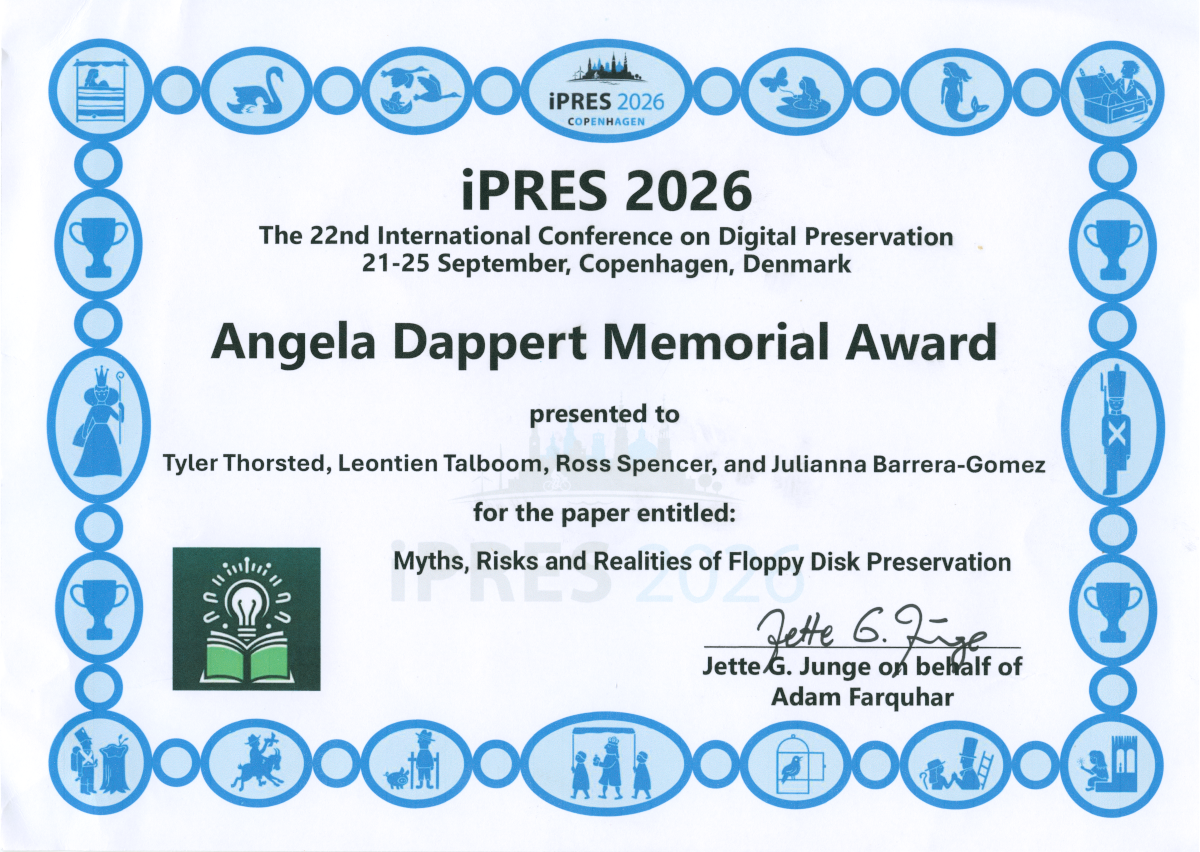
Image of the Angela Dappert Memorial Award 2026 presented to Tyler Thorsted, Leontien Talboom, Ross Spencer, and Julianna Barrera-Gomez for the paper entitled: Myths, Risks, and Realities of Floppy Disk Preservation

I am still speechless, as I am sure the rest of the team is as well. It is such a privilege to receive this award, and I am incredibly grateful to Adam for selecting us alongside previous recipients.

  • 2021 – Micky Lindlar, Merle Friedrich, & Miriam Reiche, (TIB (Technische Informationsbibliothek))
  • 2022 – Andrew Jackson (The British Library)
  • 2023 – Meghan Lyon, Grace Bicho (The Library of Congress)
  • 2024 – Klaus Rechert (University of Applied Sciences Kehl); Dragan Espenschied (Rhizome); Rafael Gieschke (University of Freiburg) & Wendy Hagenmaier (Yale University Library)
  • 2025 – Matthew P. Burgess, Peter Brotherton (State Library New South Wales)

In hindsight, having the very last presentation on stage before the final keynote might have been a clue about a potential award? Even if it wasn’t a clue, following in the footsteps of many great presentations at an exceptionally deep, and diverse, conference was quite a bit of pressure.

I suspect we were all a little nervous, I definitely was, and as a result I lost my way in the slides a bit, and there were a few points I really wanted to labor on.

The slides for the presentation are available on Google Drive.

As for those few points I really wanted to emphasize, at least I have a chance to write about them below.

Loading

Photographed at the Whitney Museum in 2018 the image shows a print by artist Edward Meneeley from his series IBM drawings. The image is bright green and shows a component of a computer or maybe printer that is stamped across the page. You can find more information at The Whitney: https://whitney.org/collection/works/7225

Shortened links? Expand them and save the URLs

Shortened links are a digital preservation and web archiving nightmare. You can imagine how they need to work:

  1. Create a unique short code for a given (target) URL (like a hash, but far far shorter)
  2. Pair the short code with your URL in a database.
  3. Create a redirect rule on the URL shortening server from the new source URL to the target URL.
  4. Send the shortened link to the caller, e.g. shortURL.com/123badf00d
  5. In-perpetuity: continue to pay for your domain; maintain the database; look after redirect rules during server migrations; ensure duplicate short-codes are not created.

A URL-shortening business in five easy steps.

But what does that mean for digital preservation?

Loading

Image from July 2021 depicting the fields around Ravensburg in Southern Germany. There is a sign with some graffiti on which depicts a car sliding off the road, presumably because there is very little curb and it's likely you will career into the grass if you're not careful.

When you can’t pay for things the currency of payment is psychic…

Contributing back to the commons in digital preservation hasn’t been for everyone.

We know the famous XKCD that touches on the underappreciated work of maintainers in obscurity. When you, or your institutions, or services are using free and open source software, or other information and data in the commons, and you’re not contributing back, you’re perpetuating this, and what’s more, there’s a virtuous cycle that we’re missing out on.

I read something the other day and it felt like a red flag.

Loading

NASA Wakeup Calls banner featuring a sunrise over the earth's horizon. glowing over the right hand side of the image, and the project logo in the left hand.

Turning NASA Wake-up Calls into data

For a while back then I was into space flight again. Scientists, science communicators, and engineers were all excited for a new era of rocket launches and the potential unification of the human race as we look towards the future.

During that time I discovered Colin Fries’ work in the NASA History Division to document all NASA “Wake-up calls”. A wake-up call is simply a piece of music used to wake astronauts on missions, a different piece of music, daily, for the duration of the flight.

Take, for example, the last Space Shuttle mission (Space Transportation System) STS-135; it was in flight for 13 days, and the wake-up call on day one was Coldplay’s Viva la Vida, while on day 13 it was Kate Smith singing God Bless America.

As a huge music buff who has the radio or music television on 18 hours a day, I really wanted to delve into this further. While Colin’s work is great, it’s just a PDF file (@wtfpdf). A PDF is not an ideal file format for querying data and gleaning new insights. So, while I wanted to explore it, I first decided to turn it into a true dataset. The result was a set of resources, a website, a JSON, a CSV, and an SQLite database which are each more functional and more maintainable over time.

Lets take a look at the results and https://nasawakeupcalls.github.io below!

Loading

Crayola's 1997 Techno Brite crayon set with color names created to market the Crayola website, including names featured here such as World Wide Web Yellow, Point and Click Green, and Cyber Space Orange

Looking after your URLs: tikalinkextract eight years on

We might not have a second life, but what if I told you there was a second internet? Not the deep web, but another web that we engage with nearly every day?

Think about it, that QR code you scanned for more information? That payment link you followed on your electricity bill? The website you’re told to visit at the end of a television ad?

The antipodes of the internet are these terminal endpoints, material and not necessarily material objects that represent the end of the freely navigable web — the QR code on a concert poster is the web printed onto the physical world. There is every chance it will be scanned and followed by someone from a mobile device, but it’s a transient object, something that will exist for a short amount of time, and then disappear into the palimpsest of the poster board or wall it was pasted on until it eventually disappears.

This is part of the materiality of the internet that has long fascinated me. Perhaps it comes from being a student of material culture, but if we look around, we see the Internet everywhere!

Loading

An slide excerpt from my presentation Declarative Programming for Digital Preservationists showing how network effect can be embraced and side-effects are reduced in the declarative paradigm.

Declarative programming for Digital Preservationists @ NTTW8

Just released on the No Time to Wait (NTTW) YouTube channel is my presentation from NTTW8 in Karlsruhe, Germany. (Slides also available here).

The presentation follows up on my proposal for iPRES 2024 and allowed me to present parts of what was, in the end, a pretty significant paper (in terms of word count).

Some of my reflections on the presentation are below.

Loading

A screenshot of a file format (fmt/983) in 0xffae. The title 0xffae sits over the top of the original image.

File formats as Emoji: 0xffae

tldr: https://emoji.exponentialdecay.co.uk

File Formats As Emoji (0xFFAE or 0xffae) might be my most random file format hack yet. Indeed, it is a random page generator! But it generates random pages of file formats represented as Emoji.

The idea came in 2016 with radare releasing a new version that supported an emoji hexdump. I wondered whether I could do something fun combining file formats and the radare output to create a web-page.

Along came a spare moment one weekend, some pyscript, and bit of sqlite, et voilà. File Formats as Emoji (0xFFAE) was made a reality.

Loading

Follow

Get every new post delivered to your Inbox

Join other followers: