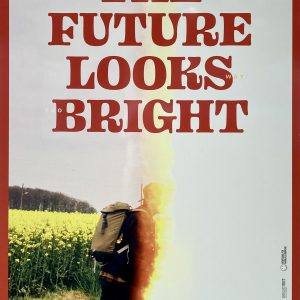
Does the future look bright? Or are we entering digital dark times? Image is a photo of a poster taken in Ravensburg, September 2021. The original image is from Benni Erbsland from the Erwegung fur Radikale Empathie (Movement for Radical Empathy) based out of Stuttgart: https://bewegung-fuer-radikale-empathie.de/benni-erbsland/

Digital dark times: Salaries in digital preservation

The Serpentine is one of the world’s most renowned art galleries. Their exhibitions as varied as Gerhard Richter, Damien Hirst, and Marina Abramović. They don’t hold a permanent collection, instead, they provide a space for temporary collections and an annual pavilion, the pavilion designed by luminaries such as Zaha Hadid, Frank Gehry, and Ai Weiwei.

Given a recent job posting it looks like they are looking at maintaining their memory better and branching out into digital preservation.

Here’s the kicker — its salary band is GBP 35,000 to GBP 38,000. So it must be an entry level position, especially in London, right?

Well, let’s see what they want you to do for that price tag…

Loading

The Painter Goblin becomes corporeal by having its prints converted from digital to canvas in real life. In this image, the Painter Goblin canvases arer bathed in sunlight provided by a west-facing window around sunset. The grid used to display the Painter Goblin in a salon style shadowed by the window frame onto the wall. The light in this image has been enhanced to increase its saturation to mirror the vibrancy of The Painter Goblin's original image.

The Painter Goblin: Becoming Corporeal

When you move country you have to be prepared to change quite a lot about your life. Back at the end of 2020, apart from literally everything else going on my partner and I also moved from Canada to Germany.

For me, this was my fifth or so international move (including shorter temporary stays) in as many years.

Being able to pick up sticks and move like that means living a drastically minimized life. Most of the things you have fit in a suitcase. Most of the things you have are small, and largely not overly whimsical. Sure, you can fit a few treasures into your bag, but you learn to value small ones, not things you might otherwise use to decorate an entire apartment!! 

So, what do you do when you do have an apartment to decorate?

You ask the best known painter in your family to conjure some magic, The Painter Goblin!

Loading

NASA Wakeup Calls banner featuring a sunrise over the earth's horizon. glowing over the right hand side of the image, and the project logo in the left hand.

Turning NASA Wake-up Calls into data

For a while back then I was into space flight again. Scientists, science communicators, and engineers were all excited for a new era of rocket launches and the potential unification of the human race as we look towards the future.

During that time I discovered Colin Fries’ work in the NASA History Division to document all NASA “Wake-up calls”. A wake-up call is simply a piece of music used to wake astronauts on missions, a different piece of music, daily, for the duration of the flight.

Take, for example, the last Space Shuttle mission (Space Transportation System) STS-135; it was in flight for 13 days, and the wake-up call on day one was Coldplay’s Viva la Vida, while on day 13 it was Kate Smith singing God Bless America.

As a huge music buff who has the radio or music television on 18 hours a day, I really wanted to delve into this further. While Colin’s work is great, it’s just a PDF file (@wtfpdf). A PDF is not an ideal file format for querying data and gleaning new insights. So, while I wanted to explore it, I first decided to turn it into a true dataset. The result was a set of resources, a website, a JSON, a CSV, and an SQLite database which are each more functional and more maintainable over time.

Lets take a look at the results and https://nasawakeupcalls.github.io below!

Loading

Color Theory: What’s the deal with the palettes I’m using?

Following a recent conversation, I wanted to write this blog to add some final pieces of context to my current interest in color palettes.

Binary Numbers

The Binary Numbers project was changed earlier this year following Trump’s inauguration. The original was inspired by simple musings on Data as Art. It was updated again in 2014 after the work had stalled due to technical reasons. I increased the complexity of the images, and incorporated Heritage Color Palettes.

But the end of last year and the beginning of this were exhausting. Two months were spent in protest:

But it seems that this alone was not able to tear the wheels off a tanker in Tienanmen Square… and so I decided on something uplifting. For myself, and for the viewer.

Cinema Palettes was a fantastic Twitter account that takes a scene (not necessarily iconic) from a film and analyses the scene’s colors, presenting back to us, the palette used.

I had been following it for a while and I became curious as to what I might be able to do with it in the configuration of my Binary Numbers.

And so from January this year I adapted the Cinema Palettes concept into this work starting with 50 new color palettes.

Loading

Rendition of Mondrian: Composition with Grid 1 from the Museum of Fine Arts Houston, remixed by the Painter Goblin

The Painter Goblin Visits The Museum of Fine Arts, Houston: Top Five

I’m heading to Houston for the first time this Friday, for ten-days. I can’t wait! To fill my time before I go, I thought I’d pay tribute to some of the artwork I might find there. Well, I say me, but I mean, I asked The Painter Goblin to make these pieces for me based on what it could find on wikidata.org. I like what it discovered!

Enjoy!

Loading

A disused railway line at the Don River Valley in Toronto

Published: Archives and Manuscripts, Binary Trees

This week (beginning 7 August 2017) marks my second solo published peer-reviewed paper. Binary trees? Automatically identifying the links between born-digital records. I invite everyone to have a read and let me know what you think.

The paper won the Sigrid McCausland Emerging Writers Award late in 2018.

Read the paper and additional thoughts below.

Loading

Starry Night

The Painter Goblin: Part 4, Putting it all together…

Following the previous posts, bringing this all together meant three different applications.

  • paintergoblin.py – creates the images, can be run standalone
  • wikigoblin.py – retrieves data to tweet from the Wikidata SPARQL services
  • twittergoblin.py – tweets for us! Either a random Wikidata image or from am existing Wikidata link

We create Tweetable information using the wikigoblin. We perform the Tweet using twittergoblin. In between the paintergoblin has to create his art!

We’ve seen examples of the images from the original zine.

Persistence of Memory

How do we turn this concept into something real, and automated?

Loading

Follow

Get every new post delivered to your Inbox

Join other followers: