
Why we do this work…
There aren’t many rewards in a discipline that is about taking the long term view but occasionally something comes up that you can take some pride in.
Last month, Ed Summers put out a call on Mastodon: digipres.club where he was wrestling with a CD-R format that was difficult to recognize. The disks likely held precious data belonging to his late brother.
Much of the search area had already been examined and narrowed down by folks in the community, including Misty de Meo, Roxi Ruuska, Ethan Gates, and Johan van der Knijff who all contributed suggestions and analysis..
Ed was able to share a copy of one of his disk images, and I had some time that I could dedicate to taking a look as well.
Long-story short, we were able to identify the disks, and Ed has written up the background here: https://inkdroid.org/2026/06/12/tascam/
The situation might be familiar to others: a digital file that isn’t recognized by the major file format identification tools, and yet, because of its context, you know it is something that might be important.
I have different experiences with these types of files, sometimes they are valuable (and you want to look after them), sometimes they are not (and it can still benefit you to get rid of them). The process of finding this out often follows a similar path.
In this instance the files turned out to be incredibly valuable and I wanted to elaborate on the path of discovery. Even though it really isn’t very sophisticated, I hope it will be helpful to those with unidentified digital records who might find the task of identifying them quite daunting.
From hex to (h)exposition
NB. Some of the below functions may be available on Windows through the Linux subsystem, but the post largely assumes the use of Linux, my view, the operating system of digital preservation.
Ed was able to provide a sample file, and given any example file, the first thing we need to do is take a look at it in a hex editor.
I will usually do this one of two ways:
- Output the beginning of the file so that I can get a sense whether or not the file has something that looks like a magic number or other contextualizing information.
xxd -l160 -g1 </path/to/file>
- If the file doesn’t look structured, we need to scan through the file to look for different information: We use less so that it is easier to scroll.
xxd -g1</path/to/file> | less
Tip: xxd also has a -c flag which allows you to change the number of columns on a single line. This is helpful for revealing different hidden structure in a file — maybe seen best with bitmap formats such as DICOM where medical images can start to appear in the hex editor without even beginning to look at the files through the correct rendering tool.
The first 160 bytes of Ed’s file looks as follows.
00000000: 92 35 96 39 02 78 79 4b 00 00 00 00 00 00 00 01 .5.9.xyK........
00000010: 00 00 00 01 00 00 08 00 00 00 00 60 00 00 1d 48 ...........`...H
00000020: 00 00 00 01 00 00 02 55 00 00 05 14 00 00 00 00 .......U........
00000030: 00 00 05 13 00 00 05 14 00 00 00 01 00 00 00 14 ................
00000040: 00 00 00 01 37 00 00 00 00 57 46 da 57 48 45 52 ....7....WF.WHER
00000050: 45 20 45 56 45 52 20 20 00 00 00 00 00 00 00 14 E EVER ........
00000060: 00 00 00 00 00 00 00 00 00 00 00 03 00 00 00 00 ................
00000070: 00 00 00 00 00 00 00 00 00 00 00 00 00 00 00 00 ................
00000080: 00 00 00 00 00 00 00 00 00 00 00 00 00 00 00 00 ................
00000090: 00 00 00 00 00 00 00 00 00 00 00 00 00 00 00 00 ................
The first bytes:
92 35 96 39 02 78 79 4b
Definitely look like a magic number but these don’t really appear anywhere in the popular file format tools, and don’t appear in internet searches.
You will want to search for both 92 35 96 39 02 78 79 4b and 923596390278794b when you look for these patterns in your favorite search engine (inside double-quotes), and if nothing appears immediately, to try and increase the results, reduce the bytes one by one, so, search 92 35 96 39 02 78 79 4b then 92 35 96 39 02 78 79 and then 92 35 96 39 02 78. The first results, if they appear, might be your first clues as to what this format might be if someone has already looked at them during the history of the internet.
Ed’s magic numbers didn’t reveal much and so I had to manually scroll through the file using xxd and less to see if I could find other information that might be helpful.
Little things that were interesting were lists of character sets, maybe a character map:
0000a8e0: 00 00 31 00 00 00 31 80 00 00 32 00 00 00 32 80 ..1...1...2...2.
0000a8f0: 00 00 33 00 00 00 33 80 00 00 34 00 00 00 34 80 ..3...3...4...4.
0000a900: 00 00 35 00 00 00 35 80 00 00 36 00 00 00 36 80 ..5...5...6...6.
0000a910: 00 00 37 00 00 00 37 80 00 00 38 00 00 00 38 80 ..7...7...8...8.
0000a920: 00 00 39 00 00 00 39 80 00 00 3a 00 00 00 3a 80 ..9...9...:...:.
0000a930: 00 00 3b 00 00 00 3b 80 00 00 3c 00 00 00 3c 80 ..;...;...<...<.
0000a940: 00 00 3d 00 00 00 3d 80 00 00 3e 00 00 00 3e 80 ..=...=...>...>.
0000a950: 00 00 3f 00 00 00 3f 80 00 00 40 00 00 00 40 80 ..?...?...@...@.
0000a960: 00 00 41 00 00 00 41 80 00 00 42 00 00 00 42 80 ..A...A...B...B.
0000a970: 00 00 43 00 00 00 43 80 00 00 44 00 00 00 44 80 ..C...C...D...D.
0000a980: 00 00 45 00 00 00 45 80 00 00 46 00 00 00 46 80 ..E...E...F...F.
0000a990: 00 00 47 00 00 00 47 80 00 00 48 00 00 00 48 80 ..G...G...H...H.
And a track listing with no other information:
0000ac80: 6b 30 30 36 00 00 00 00 00 00 00 00 54 72 61 63 k006........Trac
0000ac90: 6b 30 30 37 00 00 00 00 00 00 00 00 54 72 61 63 k007........Trac
0000aca0: 6b 30 30 38 00 00 00 00 00 00 00 00 54 72 61 63 k008........Trac
0000acb0: 6b 30 30 39 00 00 00 00 00 00 00 00 54 72 61 63 k009........Trac
0000acc0: 6b 30 31 30 00 00 00 00 00 00 00 00 54 72 61 63 k010........Trac
0000acd0: 6b 30 31 31 00 00 00 00 00 00 00 00 54 72 61 63 k011........Trac
0000ace0: 6b 30 31 32 00 00 00 00 00 00 00 00 54 72 61 63 k012........Trac
0000acf0: 6b 30 31 33 00 00 00 00 00 00 00 00 54 72 61 63 k013........Trac
0000ad00: 6b 30 31 34 00 00 00 00 00 00 00 00 54 72 61 63 k014........Trac
This is consistent with what you might expect on a CD.
Large chunks of the beginning of the file are repeating bytes, e.g. groups of 00s or FFs before the byte stream becomes a little less predictable and starts to exhibit what may be other structure, but unfortunately it wasn’t enough information to reveal (to me anyway) individual files, e.g. different groupings of magic number or identifying metadata.
123MB is also quite a lot to scroll through and so the next stop in our analysis is to use strings to see if we can find anything more human readable:
cat backup.bin | strings | less
We see the same information we have above:
WHERE EVER
dSNGMNG
WHERE EVER
Track001
Track002
Track003
Track004
Track005
Track006
Track007
Track008
Track009
Track010
Track011
Track012
But more information starts to appear that is helpful:
hi_sysdown:MEM, %d, GET_BLF
c#`3
c#b3B
hi_sysdown:MEM, %d, REL_BLF
<@`3@
c#`3@
c#`3@
c#b3B
K#yg='x
W2'x
c2Wsb32|c
S1Wsb3
Vrgcw
W2`s
W2'x
c2Wsa31|c
and:
c!a=d
a#r%a !
Completed takes
No armed tracks
ma#r
ka#r
Aa#r
and:
ERRO
nknow
nt PixelMap !!
ERROR ** Nothing Background !!
get M
P for PixelMap !!
Can't get MPLAPP for Graphi
ase a memory area for PixelMap !!
@!)b
c!!1Q
b1!!Q
b1!!Q
b1!!a
c a<S
g1b}
Backgr
@ PixelMap now !!
ERROR ** Can't create Backgr
ixelMa
ERROR : Unknow PixelMap !!
: Not
@ graphics area !!
.BbSacc
b11(b
Specifically, what I am beginning to see here is the structure of a programming language or compiled computer program. There are function calls, there are error messages — these would be loaded into a program at runtime for different purposes.
Some of the information in-between might be low-level machine instructions.
Back to the search engine with this information, and I am led to the open source real time operating system RTEMS: https://www.rtems.org/
Perhaps this information is the embedded operating system? Perhaps this information came from something that uses an embedded operating system?
Unfortunately the posit “an embedded system” provides far too many threads to follow.
So, back to scrolling the strings output. More clues started to pique my interest:
INTRO
MELODY
VERS
US
HOOK
SOLO
BRID
AIN
ENDING
11
12
@
14
15
GUIT
L
BASS
DRUMS
KEYB
S
WOODWINDS
STRINGS
and:
e#f3
~Po
[ BOOT ]
DSP1...N
P1...G
)@DSP2...NG
DSP2...GOOD
[ DMA ]
SCATTER..GOO
ATTER.
DMA.....GOOD
DMA.....NG
[ DSP1(1) ]
TOLS
.....NG
TACO_SH..GOOD
TACO_SH..NG
[ DSP1(2) ]
.....G
CK.....NG
CLICK..GOOD
CLICK..NG
[ DSP2 ]
...GOO
*@LRCK.....NG
SH 4FS...GOOD
SH 4FS....NG
[ D
and:
CAUTIO
No BFS FORMAT
[Yes / No]
Ver:[%2d
Capa
SONG:[%d]
[ SIZE ]
SECTOR:[%d]
CLUSTER:
[
TER ]
TOTAL :[%d]
REMAIN :[%d]
e#f3
c a<
7@WfV
Now I am thinking, MIDI, maybe “digital signal processor” from “dsp” and maybe drums, or timing track, from “CLICK”.
There is mention of FORMAT, SECTOR, and SIZE too which turns one’s thinking toward storage — maybe an old synthesizer? A digital music recording device? I wasn’t immediately thinking of one that wrote to a CD but perhaps there was an interchange format that was first written to a computer or floppy disk and transferred to a CD?
Search search search
As noted, this isn’t a sophisticated process, and relies heavily on internet search infrastructure, so at this point, we just have to search, search, search.
I’ve listed most of my search history as I was analyzing the file below:
3:01 pm  "WF.WHER 00000050: 4520 4556 4552 2020 0000 0000 0000 0014 E EVER"
3:01 pm  "WF.WHERE EVER"
3:01 pm  "WF WHERE EVER"
3:02 pm  "dSYNCTRK"
3:03 pm  "SYNCTRACK"
3:05 pm  "9235 9639 0278 794b"
3:05 pm  "92 35 96 39 02 78 79 4b
3:05 pm  92 35 96 39 02 78 79 4b
3:05 pm  "92 35 96 39"
3:06 pm  "92 35 96 39"
3:06 pm  0x92359639
3:11 pm  "5748 4552 4520 4556 4552 2020"
3:11 pm  linux tool extract text from binary
3:12 pm  "hi_sysdown:MEM, %d, GET_BLF"
3:12 pm  "hi_sysdown"
3:12 pm  GET_BLF
3:13 pm  "RTEMS ITRON"
3:15 pm  "Can't get MPLAPP for Graphi"
3:15 pm  "Can't get MPLAPP"
3:15 pm  "Can't get MPLAPP"
3:15 pm  Can't get MPLAPP
3:15 pm  "MPLAPP"
3:15 pm  Matplotlib for Python Developers (2009).pdf
3:17 pm  Home | RTEMS.com
3:17 pm  RTEMS "FseMgr"
3:18 pm  "FseMgr"
3:18 pm  "FseMgr"
3:18 pm  RTEMS i_cmd
3:19 pm  RTEMS song list
3:21 pm  yamaha keyboard cd
3:22 pm  yamaha keyboard dsp2
3:22 pm  "DSP1" midi
3:25 pm  midi "CLONE TRACK"
3:25 pm  midi "CLONE TRACK"
3:33 pm  Retrospect Backup (DANTZ Development Corporation)(Mac 4.2)(3211)(1999) : Free Download, Borrow, and Streaming : Internet Archive
3:35 pm  tascam daw
3:52 pm  DAW
3:52 pm  tascam daw
3:52 pm  read tascam788 disk
3:52 pm  tascam 788 cd format
3:52 pm  tascam 788 cd file format
3:55 pm  tascam 788 CD-R format
4:29 pm  tascam teac
4:29 pm  teac drivers
4:30 pm  TASCAM "0.00:1999/06/04"
4:30 pm  RTEMS "0.00:1999/06/04"
4:30 pm  RTEMS operating system version
4:31 pm  TEAC 0.89
4:32 pm  TEAC DAW
4:32 pm  Why I Love... My DAW
4:32 pm  TEAC788 CD format
4:33 pm  TEAC788 5.9
4:33 pm  TEAC 788 "9235 9639 0278 794b"
4:34 pm  TEAC 788 "923596390278794b"
4:34 pm  0xda ascii
4:35 pm  TEAC "WF WHER EVER"
4:35 pm  TEAC WF WHER EVER
4:35 pm  TEAC WF WHERE EVER
4:35 pm  TASCAM WF WHERE EVER
4:39 pm  Broadcast WAVE - PRONOM - The National Archives
4:40 pm  Waveform Audio (PCMWAVEFORMAT) - PRONOM - The National Archives
NB. Given some information I found about RTEMS based systems, and thinking about the era where CD-Rs were most prevalent, I also settled on a time-frame for search, and so all of my searches from this point had the additional keywords before: 2010 although this isn’t shown clearly above.
I kept following the musical theme through my searches and started to hone in on the idea that the data might come from a digital audio workstation (DAW).
I started to find more function names and keywords that started to confirm this hypothesis as well.
See also, the short list of keywords or signals that I jotted down when they caught my eye:
TEAC
TEAC
123456789012345
0.89
SCSI Driver initial start
SCSI Driver ini

Operat
&@System  ver 0.00:1999/06/04....
	cre_mpl erro
 = %x

2a#r
   mtr_exec:ERROR unknown i_fun(Cmd2MTR
exec:ERROR unknown i_fun(Cmd2SYS) !!
   mtr_
RROR u
o@wn i_fun(MIDI) !!
   mtr_exec:ERROR unknown i
c a<

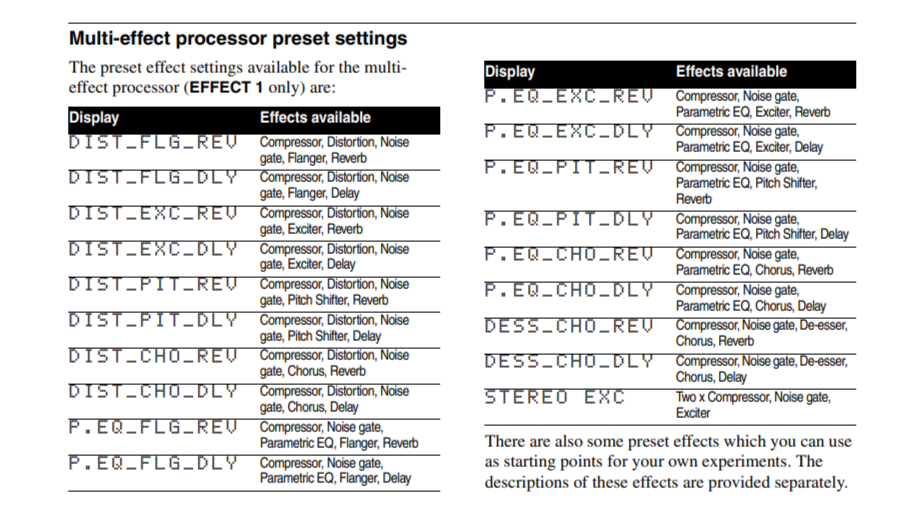
DIST_FLG_REV
DIST_FLG_DLY
DIST_EXC_REV
DIST_PIT_REV
DIST_PIT_DLY
DIST_CHO_REV

COPY
INSERT
MOVE
PASTE
MOVE
INSERT
SILENCE
CLONE TRACK
EAN OU
RECORDING
AUTO PUNCH
START UP
STERIN

INTRO
MELODY
VERS
US
HOOK
SOLO
BRID
AIN
ENDING
11
12
@
14
15
GUIT
L
BASS
DRUMS
KEYB
S
WOODWINDS
STRINGS
PERC

        ~Po
         [ BOOT ]
        DSP1...N
P1...G


        SCATTER..GOO
ATTER.
DMA.....GOOD
        DMA.....NG
 [ DSP1(1) ]
        TOLS
.....NG
TACO_SH..GOOD
        TACO_SH..NG
 [ DSP1(2) ]
.....G
CK.....NG
        CLICK..GOOD
CLICK..NG
         [ DSP2 ]
...GOO
*@LRCK.....NG
SH 4FS...GOOD
        SH 4FS....NG
         [ D
P) ]
.....GOOD
        DSP1.....NG
DSP2.....GOOD
        DSP2....
I found a manual for a device that I thought the data most likely came from, the TASCAM 788 DAW from TEAC:
And between the manual and the strings search I had been doing, grepped for function names that I was seeing either in the byte stream or the manual to begin to confirm the correct pairing. I would go back and forth between manual, grep, and search engine.
INTRO
MELODY
VERS
US
HOOK
SOLO
...
...
KEYB
WOODWINDS
STRINGS
PERC

PASTE
MOVE
INSERT
SILENCE
CLONE TRACK

DIST_FLG_REV
DIST_FLG_DLY
DIST_EXC_REV
DIST_PIT_REV
DIST_PIT_DLY
DIST_CHO_REV

On Self Test
	788 Ver[%s] ####
	GA Reset ->
(PE12) L ->
	PWAD(PE7) PWDA(PE5) L ->
	CDCR
@RESET ->
	DSP1 DSP2 RESET L ->
There are clear matches for function names in the DAW’s manual.
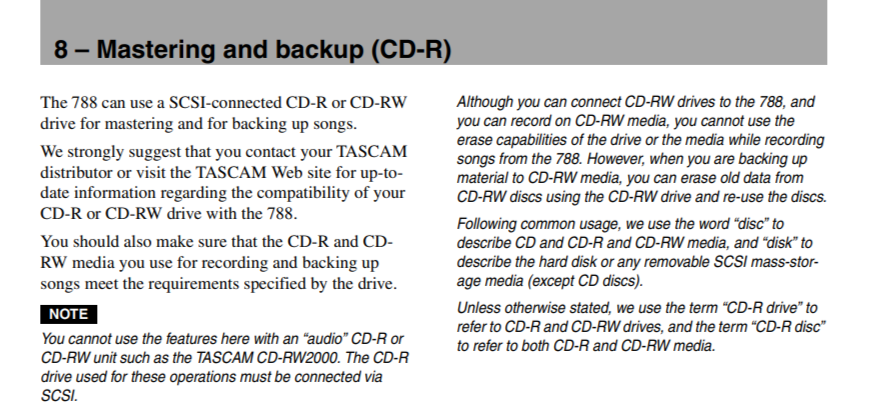
And better than that, we know that the CD we are looking at is a CD-R, could the manual reveal some sort of file format, or audio output?
Absolutely! The TASCAM 788 was capable of writing to CD-R.
One final look through the data and we can see clearly the manufacturer name in the data as well.
3380688-000c2340: 0009 7b40 0000 0000 0000 0000 0009 7b80  ..{@..........{.
3380756-000c2350: 0100 0000 0000 0000 0000 0000 b620 d2d0  ............. ..
3380824-000c2360: 39f0 d28e 39f1 d1d0 d0d2 b080 d1d2 3be4  9...9.........;.
3380892-000c2370: d1d4 b620 d180 91e0 e0e0 b702 d1d6 b704  ... ............
3380960-000c2380: 0009 7b80 0000 d0b6 e0e0 b704 0009 7bc0  ..{...........{.
3381028-000c2390: b610 d1d8 b620 d180 3ae2 d1d8 b620 d180  ..... ..:.... ..
3381096-000c23a0: 38e3 d1da b620 d180 3391 e280 91ea 91e3  8.... ..3.......
3381164-000c23b0: 91e8 91f0 91eb 91ed 91e9 8080 0000 0000  ................
3381232-000c23c0: 0009 7bc0 0000 0000 0000 0000 0009 7c00  ..{...........|.
3381300-000c23d0: 0000 0000 0000 0000 0000 0000 0300 0282  ................
3381368:000c23e0: 1f00 0000 5445 4143 2020 2000 3132 3334  ....TEAC   .1234
3381436-000c23f0: 3536 3738 3930 3132 3334 3500 302e 3839  56789012345.0.89
3381504-000c2400: 0009 7c00 0000 000a 0000 0000 0009 7c40  ..|...........|@
3381572-000c2410: 0000 0009 0a53 4353 4920 4472 6976 6572  .....SCSI Driver
3381640-000c2420: 2069 6e69 7469 616c 2073 7461 7274 0a00   initial start..
3381708-000c2430: 0a53 4353 4920 4472 6976 6572 2069 6e69  .SCSI Driver ini
3381776-000c2440: 0009 7c40 0000 6e64 0a00 0009 0009 7c80  ..|@..nd......|.
3381844-000c2450: 4f22 7ffc 6ef3 61f3 d21d 6423 d81d 480b  O"..n.a...d#..H.
3381912-000c2460: 0009 61f3 e400 e500 d81b 480b 0009 e100  ..a.......H.....
3381980-000c2470: 2e12 7ffc 61f3 e200 2122 e401 65e3 e602  ....a...!"..e...
3382048-000c2480: 0009 7c80 0000 0009 7f04 7ffc 0009 7cc0  ..|...........|.
I reached out to Ed to see if it is likely his brother had this device or if this data might come from a DAW and he provided a strong definitely maybe!
Converting the data to audio
My analytical mind needed to recharge at this point but fortunately Ed had enough information to then look at how to convert the data.
Within an hour or so Ed got back to us. He had managed to get the data by pointing it at the audio processing application Audacity along with some information about the data’s potential offsets.
i’m pretty sure i wouldn’t have got to that point in short order but a team effort found a result in much quicker time. And now Audacity will become a new tool in my own digital preservation toolkit!
Unsophisticated but effective
I love my long meandering stories and blogs and so writing this one feels weird.
So, what exactly did you do Ross?
I looked at ASCII in a hex editor and I used a search engine to hone in on the information I was seeing.
Yes, I have a professional background in software development (and have looked at a lot of hex in my past life reverse engineering VoIP protocols, and in digital preservation), and I have an amateur background in music theory and music production-lite, but in a different context, the background you bring to the table, and the knowledge you have, be that in construction, architecture, art history, or anything else! Might all reveal clues to your next digital discovery — and it doesn’t take a lot to turn that knowledge from digital unknown to digital forensics — or at least start out on a pathway toward digital forensics. That’s the takeaway.
Even if it seems ambitious to begin with:
- Use your hex editor,
- Ask your colleagues,
- Find clues,
- Build on the knowledge you can find gradually…
Thinking about embedded systems and embedded devices, rightly or wrongly propelled me to think about digital music, and I used my confirmation bias to exhaust that theory — in this instance it paid off. If I had to walk it all back, then i think following the embedded systems idea in a different direction might still have been a strong one and I might then have looked more closely at different obsolete file systems to see where that path took me.
The internet is our most vital resource
Enshittification is a well-documented phenomenon. Combined with AI slop searches and the guardrails being setup around important websites to prevent AI crawling, the future of the search engine is uncertain.
I think it almost impossible to think of what I would have done to help Ed in this instance without a search engine.
It’s important for you to start saving all of your important manuals and documents to the Internet Archive (IA). I hope one day a global search engine will exist to provide OG “Google-like” search on top of the IA and other memento instances.
Please support the IA, and if you find a search engine with good principles and ethics, please support those too. They are vital for the survival of digital heritage.
And what would we do without search?
Honestly I have no idea. In the past, people released books about file formats and so we might start there.
Websites that still act like directories (like the Just Solve It Wiki) are also helpful to narrow our focus.
But internet search is still massively important, so I think we need to update Maslow’s hierarchy of needs AGAIN:
                        /\
                       /  \
                      /    \
                     / SELF-\
                    / ACTUAL-\
                   /  IZATION \
                  /------------\
                 /   ESTEEM &   \
                /  RECOGNITION   \
               /------------------\
              /   LOVE & SOCIAL    \
             /       BELONGING      \
            /------------------------\
           /     SAFETY, HEALTH &     \
          /       PHYSICAL SHELTER     \
         /------------------------------\
        /         Wi-FI SIGNAL           \
       /      (NETWORK CONNECTION)        \
      /------------------------------------\
     /               BATTERY                \
    /             (DEVICE POWER)             \
   /------------------------------------------\
  /          INTERNET SEARCH ENGINE            \
 /              (ACCESSIBLE INFO)               \
/________________________________________________\
What next for Ed’s format
It’s important to share the knowledge gained during this process for others who might have similarly DAW ripped CD-Rs.
I have it on my list to add Ed’s blog and this one to the Archive Team’s Just Solve It Wiki, and maybe see if I can find more sample files. At a minimum we can share the magic number on there, and maybe find enough information to create a Wikidata entry, even if we don’t have enough information for a PRONOM one. But let’s see.
It’d be great to find a name for file the format, but in lieu of anything else, TASCAM 788 CD-R Format might work well enough — we can workshop it 😉
Ed documents a script for extracting data from these disks, We can share information about that on the Just Solve It Wiki as well. One thing I might add to those scripts is some information about extracting the original/draft song title:
00000000: 92 35 96 39 02 78 79 4b 00 00 00 00 00 00 00 01 .5.9.xyK........ 00000010: 00 00 00 01 00 00 08 00 00 00 00 60 00 00 1d 48 ...........`...H 00000020: 00 00 00 01 00 00 02 55 00 00 05 14 00 00 00 00 .......U........ 00000030: 00 00 05 13 00 00 05 14 00 00 00 01 00 00 00 14 ................ 00000040: 00 00 00 01 37 00 00 00 00 57 46 da 57 48 45 52 ....7....WF.WHER 00000050: 45 20 45 56 45 52 20 20 00 00 00 00 00 00 00 14 E EVER ........
Right there at byte 0x77 “WHEREVER” which based on the lyrics on Ed’s brother’s music, I believe is the title this song was drafted with.
An emotional connection to archives
it was touching to hear Ed’s brother John’s voice and music. And touching to think that this job can sometimes make a difference.
I’ve discussed emotion in the archive before. These moments don’t happen too often but when they do, hold onto them, they help you get through some of the tedium, the low-pay, the lack of jobs, the lack of funding, especially for research, and some of the other sub-optimal aspects of jobs day-to-day. Yes, I think we can solve those issues one day too, but until then, these are the moments that can help.

@exponentialdecay I'm so glad to see that you and Ed were able to put together the pieces of this puzzle, especially given the importance of the content. Thank you for sharing the outcome!
Remote Reply
Original Comment URL
Your Profile
Why do I need to enter my profile?
This site is part of the ⁂ open social web, a network of interconnected social platforms (like Mastodon, Pixelfed, Friendica, and others). Unlike centralized social media, your account lives on a platform of your choice, and you can interact with people across different platforms.
By entering your profile, we can send you to your account where you can complete this action.
I just saw one of these for sale at a second hand shop today. Maybe should have picked it up!
Bonus points if it comes with the CD drive!
@exponentialdecay been reading on the other tread. super cool writeup
Remote Reply
Original Comment URL
Your Profile
Why do I need to enter my profile?
This site is part of the ⁂ open social web, a network of interconnected social platforms (like Mastodon, Pixelfed, Friendica, and others). Unlike centralized social media, your account lives on a platform of your choice, and you can interact with people across different platforms.
By entering your profile, we can send you to your account where you can complete this action.